Showing posts with label gay rights. Show all posts

Tuesday, December 10, 2024

TRANS ACTIONS


We’ve got to do better. When we say, “It gets better,” that must apply to everyone in the LGBTQ community. That includes trans. We’ve got to step up and continue the fight for queer dignity and queer rights.


Frankly, I knew throughout election season that, not only were trans people being demonized during the campaign, but they would then be blamed by their own side if Democrats lost the election. It’s doubly disgusting. The demonizing worked AND allies, needing to lay blame, pointed fingers at trans pronouns, athletic participation, bathroom usage and early hormone inhibitors. 


To be clear, blame does not belong to the trans community. Trans rights were not handled well by the left. Democrats were always playing defense or not playing at all and, in such situations, it’s pretty difficult to score. 


The weekend after the election, both The Wall Street Journal and The New York Times published front page stories analyzing the result, clearly stating that trans rights proved to be a deciding issue. The WSJ article focused solely on the topic, the headline stating, “Transgender Rights Took Center State Late in Race.” The article’s summative point: “[A]s the campaign neared the finish line, it was the transgender debate that emerged as a powerful force that—along with..inflation and immigration—worked in Republicans’ favor and against Harris.”


An effective campaign conducts its research and highlights the issues and stances that will play best to its key voters and those who are undecided. According to the WSJ, “The Trump campaign spent heavily on transgender issues, accounting for roughly one in five ads it aired in the last couple of months,” costing $37 million. [Emphasis added.] The Harris campaign failed to grasp the damage caused by the ads. It did what Democrats have too often done—ignored issues and statements deemed outrageous. “Harris had an opening to address one of those ads, which focused on her support for taxpayer-funded transgender surgeries for federal inmates, during her combative Fox News interview…[b]ut she ended up dismissing the importance of voters’ concerns on the issue.” Really, how many inmates would be getting trans surgeries in a year? As obscure as the issue may be, the ads caused the voter outrage Republicans sought.


This slogan is familiar, but I contend
it hasn't been effective enough.
Time to try a new soundbite.

Never ever let Trump statements go unchecked. Never let distortions go without a strong, soundbite-savvy response. Indeed that ad’s soundbite was “Kamala’s for They/Them. President Trump is for you.” 


No strong, easily grasped response from Democrats? Hello, damage. 


Same goes for all the fear and outrage lathered up over trans athletes. Even Representative Seth Moulton (D-Mass.) felt freaked out by the issue, telling the NYT, “I have two little girls, I don’t want them getting run over on a playing field by a male or formerly male athlete.” I literally cringed from the quote. Even Democrats don’t understand trans issues or the extent to which issues have real life impact. The director of communications for the Michigan High School Athletic Association told the WSJ, “the issue of transgender girls playing girls sports was inescapable on the airwaves” despite the fact only two girls playing on high school teams in the state were trans. Two out of 170,000. A non-issue, spun hard by Republicans. 


Without effective pushback, all that outrage and fearmongering has caused damage to trans people and trans issues beyond election season. 


Yes, we failed. We weren’t there. We silently shook heads, tantamount to no response at all. I, for one, await both grassroots and well organized (non-election) campaigns to boost positivity and acceptance regarding people who are trans. 


*  


History is indeed cyclical and we only need to look at earlier LGBTQ struggles to see when things stalled and when real progress finally happened. 


Throughout the seventies and eighties, progress for gays and lesbians was slow. Singer Anita Bryant stepped up as a leading adversary. Senator Jesse Helms relentlessly called out gays as sinners, lumping them in with perverts and pedophiles. AIDS worsened any campaign for gay rights. While gays were in survival mode, bathrooms became a danger zone, with the false perception you could become infected from toilet seats seemingly unshakable. It was in conservatives’ best interest to allow the falsity to persist. Whatever it took to make people remain entrenched as anti-gay. Play it up enough and it meant Republican votes. 


Bathrooms remain big in conservative playbooks. So do families, especially children. Once, it was gay men who posed a threat. Recruiters! Abusers! Protect our kids.


Updated to trans hate, conservatives now perpetuate pedaling fear that their children will be harmed. “Biological boys” are invading girls’ bathrooms and taking over girls’ athletics! Again, there is little to no substance, no cases put forth as they continue to spin fear. Worse, one common Trump lie at rallies was that parents could send their child to school in the morning and that child would come home the opposite sex. 


Sometimes we think Trump’s statements are so outrageous and clearly untrue they don’t get enough pushback. The fact is many Republicans drink whatever Kool-Aid Trump’s serving. They may not truly believe what he spouts, but they’ll spout it too in the name of team spirit. I’ve said many times, Trump and his supporters remind me of WWE arena wrestling—all staged but totally consumed. 


Where gays finally made significant strides was during marriage equality campaigns.


Progress was not entirely linear. There were setbacks, even in California, which saw the passage of the Proposition 8 referendum, which took away the right to marriage. But the organization became stronger. 


One legacy from the AIDS crisis was that gays and lesbians honed advocacy skills. One of the first changes was that more gays came out. They couldn’t sit back quietly while so many gays died. They couldn’t let stand hateful rhetoric that AIDS was God’s wrath. They became politically and socially active because they had to, pushing for more AIDS funding, quicker approval of experimental drugs and protections from job and housing discrimination. Gay men were not united in what was the best approach. Some worked within the establishment while others focused beyond it. 


A generation of gay men became well-versed in political and social action. Their experiences then helped with marriage equality efforts. They had a sense of how to mobilize and a track record of what tactics and strategies were most effective. Marriage campaigns at the state level worked together. Each state that passed marriage equality legislation provided momentum. Bit by bit, change happened.


In my mind, one of the most effective aspects of the overall campaign was the creation and propagation of a positive, social media friendly sound bite: #LoveIsLove.


Where is the trans sound bite? 


It’s time for gays and lesbians to join all queers in mobilizing again. We have the experience. We have a better opportunity to affect change with greater numbers of people actively pushing for it. And let me be clear in stating that any gay man latching onto “LGB but not the T” is spinning selfish, hateful nonsense that should be left behind in the last century.


It would have been nice if the Democrats had a solid plan to respond to political potshots—no, attacks—regarding trans issues. Nicer if the response not only responded to fearmongering but also put a positive foot forward. If some Democrats believe trans issues hurt them, it’s on them to regroup and rethink how to effectively campaign for trans rights. It’s a no-brainer that, if Republicans found success scaring voters about trans issues, they’ll keep doing it as long as they’re given carte blanche to do so. 


But I think it’s incumbent on major queer organizations to strategize their own counterattacks and, more importantly “brand” trans identity as something positive. That’s right, “brand” it. This is something to sell in terms of politics. There needs to be a #LoveIsLove equivalent that people can embrace and that catches on. Keep floating them out there, see what sticks and then fly with it. Something with long legs. Gay marriage has been legal since the Supreme Court’s 2015 decision and people still #LoveIsLove all over the place, perhaps as much as they wave the Pride flag. 


A personal suggestion is #LetThemBe. It’s positive. It’s got the pronoun so many associate with trans, nonbinary and other queers. (I do realize many trans people go with she/her and he/him, but I think #LetThemBe gets a simple, positive message across. If a trans person does choose she/her or he/him, well that’s even easier for straight folks to go with. Less pronoun bumbling if they choose to get past archaic resistance with comments like, “You don’ sound like a woman.” (Yeah, I hick-ified it. It seems apropos.)


A friend of mine who is trans told me shortly after the election that many trans people are antiestablishment. They won’t get on board a united, seemingly centrist campaign that speaks to acceptance from straights. That’s not their raison d’ĂȘtre.


My response was that was fine. Historically, with gay rights, there has been more than one track. During the AIDS crisis, organizations like Gay Men’s Health Center in NYC and AIDS Project Los Angeles appealed to politicians and celebrities for support while ACT UP went with more controversial, in-your-face tactics that some gays felt were a distraction or even detrimental to the cause. I didn’t always like ACT UP’s actions, but I believe that, while traditional organizations went with diplomacy, there was also a time and place for agitation that occurred per ACT UP’s agenda, not GMHC’s.


Too often in politics, things take on an either-or, black-or-white dichotomy. Explore all channels. Let the pro-trans movement have diversity in the channels it pursues.


If we all get onboard advocating for trans rights, we can contemplate bigger actions and fund a campaign to counter that $37 million anti-trans advertising effort the Republicans put together. Yes, money matters.


What are the key organizations to contribute to in advocating for trans rights? A specific trans organization doesn’t come immediately to mind which underscores how much has yet to be done. During the AIDS crisis, ACT UP was known to most everyone. GLAAD and HRC are also well known, but they have broader agendas than solely advocating for trans issues. (We still need to donate to them and push them to strengthen their trans campaigns both in terms of people and resources.) What is a key trans advocacy organization? One or two need to emerge as having household recognition, spearheading campaigns, becoming prominent fund raisers, organizing a powerful national march, targeting states where change is likely to occur, building momentum off these wins and assuming an advisory role with state- and local-level organizations working to establish and/or protect particular rights.


If the LGBTQ community doesn’t show in bold ways how it is stepping up, how can we expect our allies to show up and grow. If we organize in bigger numbers with bigger coffers, we can also establish an expertise that can then better advise Democrat positions and responses—there MUST be responses—during the 2026 and 2028 election campaigns. Do better, yes, and do more. Let’s go!


Newspaper articles cited for this blog post:

“Democrats Sift Through Rubble, Seeking Answers: Assigning the Blame,” The New York Times, November 10, 2024.


“Transgender Rights Took Center Stage Late in Race,” The Wall Street Journal, November 9-10, 2024.


Saturday, November 12, 2016

ET TU?


What now?

Yes, I was wholly disturbed and disheartened by Tuesday’s election result in the U.S. What seemed a novelty to the press and the public sixteen months ago actually came to be. Donald Trump will be the next president of the United States. How did a country that endorsed Barack Obama for two terms turn to Trump as his successor? How did a hate-spewing and hate-sanctioning egotistical billionaire become the answer for people who felt they didn’t have a voice in government? As a Trump presidency looked more and more like a reality on Tuesday night, I tweeted, “I can’t cope.” Still can’t.

But something more personally disheartening came to light Wednesday morning. I scrolled through Facebook posts, knowing that many of my American friends would be despondent. I wanted to commiserate and perhaps offer something hopeful. At least you’re in a blue state. Hillary got more votes. Red cups are coming to Starbucks. To be sure, there were many people to try to console.

There was the predictable post from my Baptist sister-in-law, praising God for the Republican triumph. I do my best to ignore whatever she writes. She’s too far gone. (She’d say the same of me.) And my mother, a self-declared “independent” who has never voted Democrat but sat out the vote for the first time ever, expressed relief that Hillary would not have a national stage to bash cookie-baking, stay-at-home moms. Apparently some anti-cookie Clinton comment made two decades ago is the closest my mother has ever come to having her identity bashed.

But then I glimpsed a post from a friend in Dallas. I had to read it three times, certain that I’d misread it due to my sleepless night.

Living through amazing history. A beautiful day and warmth in my heart.

America you continue to surprise. Here we go. About to Make America

Great Again!

I do have a few friends from my days in Texas who are clearly Republican. We went to high school or university together. We have the past, if not the future, in common. But I got to know Ben while working in a department store part-time as I had to supplement a then-paltry teacher’s salary from a private school (since I couldn’t work in public school without declaring an intent to become an American citizen). Ben was far more social than I was and he invited me along with other “sales associates” to restaurants after work. Eventually, Ben got me to join him and a smaller group of his friends at clubs. Gay clubs. Yes, despite my being firmly settled in the closet—it seemed the safer option in Texas—Ben figured me out. He was one of my first gay friends.

And now this. How did my eternally optimistic, treat-everyone-with-kindness pal become an apparently rabid Trump fan? It’s more baffling, given that he is Mexican-American and has an immigrant boyfriend from Vietnam. I’m stumped.

I’m aware that people can have differing views, on religion, on politics, on whether pineapple belongs on pizza. (It doesn’t.) I’ve known about Log Cabin Republicans, gay men who align with The Other Side. Okay, I’ve at least heard they exist, like alien life forms, Rob Schneider fans and The Great Pumpkin. And I thought this was the year that even gay Republicans couldn’t endorse their party’s candidate.

So what did Ben see that the rest of us didn’t? How can anyone whose identity has been bashed by hate while growing up set aside the vile Trump so easily spewed and condoned? How can any other issue trump human dignity? I’m not ready to ask. Frankly, there was a moment when I thought I’d have to “unfriend” Ben. I don’t seem to know him anymore. And, really, I don’t. Haven’t seen him since he flew from Dallas and I flew from L.A. to meet in Seattle in 1992. Time passes but what about core values? I may never understand Ben’s thinking. This is not something to be hashed out on Facebook. For now, I’ll continue to “Like” his photos from his world travels as part of his job and I’ll politely take in his comments that I don’t seem to age—I do get to choose which pics I post, after all.

Despite my dismay, I’m coming to accept the fact that Trump happens. Sometimes even to truly good people.


Friday, July 17, 2015

HAVE WE FORGOTTEN?

I cannot forget.

The AIDS crisis happened. Millions of people died. Some of them I knew.

Farrell.

Stephen.

Don.

Steve.

Greg.

AIDS overshadowed my coming out process. Fear of death kept me from any period of sowing my wild oats. There were options, of course, but I always read “safe sex” as safer sex. And I was never much of a risk-taker.

I’d first heard of it watching a report by Geraldo Rivera on ABC’s “20/20”. At the time, it was called GRID, Gay-Related Immune Deficiency. Some rapid-moving disease was afflicting gay men, radically transforming their appearance and killing them. I watched the report while sitting uncomfortably alongside my parents in my family’s den in East Texas. At the time, I was conflicted and closeted. Concrete walls. Dozens of padlocks. I’d told my college roommate that I’d decided to be celibate for reasons I bumbled through. College and celibacy made for an odd cocktail. Innately, I was a survivalist. This was Texas. To be gay was to be a sinner, a pervert, a future pedophile. (It was a package deal.) And now it looked to be the target of a new holocaust.

It would not be much of an overstatement to say AIDS was always on my mind from 1985 to 1995. The first gay book I ever read was E.M. Forster’s posthumously published Maurice (1971). (Forster finished the first draft in 1914 but deemed the topic too taboo for publication.) It was a magical read that captured the fear in acknowledging my homosexuality but also the hope that love could come. The second gay book I ever read and the first I ever owned was And the Band Played on: Politics, People, and the AIDS Epidemic by Randy Shilts. This read offered no hope, only frustration, deep sadness and intense anger. I still tear up just looking at the cover of a book that informed me but also helped embolden me to remove one or two of those padlocks. My copy of the book found a place on a bookshelf instead of finding cover in the sock drawer.

I read every article I could find in newspapers. I scanned pamphlets from the Dallas AIDS Resource Center. I followed television reports and eventually began looking in professional journals. There seemed to be no hope in terms of treatment. If there was any feel-good element at the time, it was that AIDS was experiencing its own coming out. Anytime a politician spoke the word AIDS, it made headlines. Researchers began sharing findings at global conferences. And sometimes a prominent person had the gumption to tell Jesse Helms to shut up. It seemed there were little battles to be won in what was still overwhelmingly a lost cause.

It’s weird to think that AIDS helped me come out. It got me out of the bars in West Hollywood and allowed me to establish my first gay friendships that didn’t evolve from failed pickup lines. I even found love for the first time in my life after being introduced at an AIDS volunteer appreciation gathering. My AIDS buddy group facilitator dragged me onto the dancefloor, told me to stay put and then dragged out a certain AIDS Project Los Angeles employee. “You two should get to know each other.” And so we did.

At some point in the mid- to late-1990s, I began reading less about AIDS. At first, I’d skim the first paragraphs of an article, then I’d just glance at a headline. There had been some hopeful signs, but I’d hit AIDS overload. And then I received the news of my Dallas friend Farrell’s death through a Return to Sender stamp on a returned card I’d mailed him shortly after my move to Vancouver. Reason for Return: Deceased. He’d never dared to confide in me that he had AIDS. Living in Texas, the stigma remained too great. I think that’s when hope died within me. This extraordinarily kind, gentle soul, ultra-conscientious and responsible, a man with no family and few friends, likely died alone at the ripe old age of thirty-five. There was no answer to “Why?” I pulled away.

And almost at the moment I stepped back, real progress started to happen. People I knew who were HIV positive stayed like that. They averted what was supposed to be the imminent AIDS diagnosis. I still see them in passing today, twenty years later. No cure, but something that can be managed.

Wonderful, wonderful progress. It’s what we all yearned for so impatiently in the late 1980s and early 1990s and what most of us probably became resigned to not happening. Not in our lifetimes, however stunted they may turn out to be.

Maybe it’s because improvements in managing HIV and AIDS happened over time that there was never a time to celebrate as with the end of a war. It took so long and yet seemed to happen quietly overnight.

For the most part, these are good times to be gay, at least in a growing number of countries. The euphoria and expressions of Facebook support that came with last month’s U.S. Supreme Court decision on same-sex marriage have no doubt made this summer’s procession of Pride Festivals in North America all the more festive. Let us indeed feel the joy.

And, yet, let us remember as well. Like the Holocaust, remembering is somber and many people don’t want to go there. Why do they keep bringing THAT up? According to amfAR (American Foundation for AIDS Research), nearly 39 million people have died of AIDS-related causes and more than a million people each year continue to die. Much remains to be done in less developed areas of the world. But even in places where treatments to manage HIV are accessible, there remains stigma and managing it comes at financial, physical, mental and emotional costs.

I’ve lamented before, but I fear we’ve become complacent. And I sense that the generation younger than us lacks perspective or any real appreciation about the decimating impact of AIDS on gay life and culture. Being back in Vancouver, I can access events that never made it to my rural area. A case in point was the screening of the 2012 Oscar-nominated documentary “How to Survive a Plague” which played at a branch of the Vancouver Public Library two nights ago. I had read about the film when it was first released but there was no possibility to see it. A friend of mine thinks it may have had a few showings in Vancouver shortly after its release. Its total box office take was a paltry $132,055.

I saw a poster for the screening two weeks prior and excitedly photographed it and texted it to a friend. “Want to go?” It took him a day to respond but, yes, he was in. Being a free event, we knew seats would fill early. The day of the screening, my friend went online and learned that tokens for the screening would be given out an hour ahead of time. We were there even earlier. (There proved to be an added benefit as my friend shocked me in saying, “I haven’t been in a library in years.” He did some important sightseeing—“Wow. I thought all the books would be old and smelly.”—while I returned some books and used the internet to post a blog entry.)

With our tokens in hand—Victory!—we grabbed dinner at a nearby Thai joint and returned fifteen minutes before the 6:30 screening. We were the first to claim our seats. To my shock, there were less than fifteen people in attendance when the documentary rolled. (Three teens with fast food sodas popped in half an hour later, talking loudly and shuffling about. Two ducked out after three minutes; one stayed for a solid ten.)

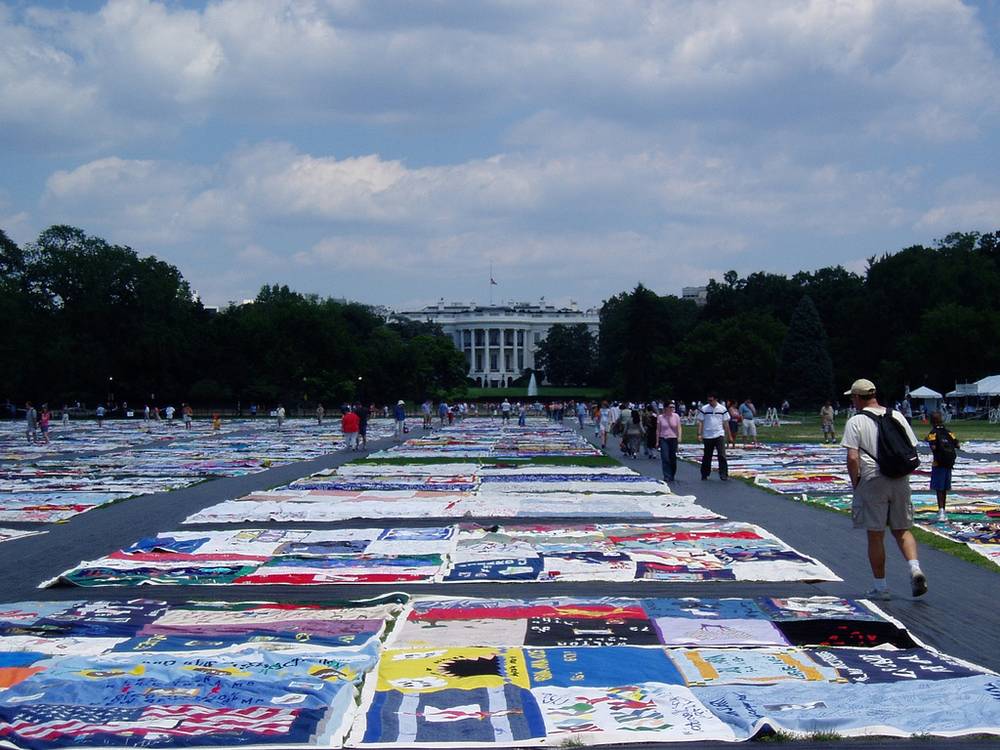
It’s an important film, one that chronicles the efforts—some might say antics—of ACT UP and offers insightful perspective from those in the archival footage who indeed survived. It also shows us real heroes—people like Mark Harrington, Iris Long and Peter Staley. And it brings back the always agitated Larry Kramer—the world needs Larry Kramers, as polarizing as they may be—and Dr. Anthony Fauci, a man whom I’d once pinned so much of my hope on facilitating an early breakthrough. It reminds us of the AIDS Memorial Quilt, now warehoused in Atlanta, and not displayed in its entirety since, shockingly, 1996. Wouldn’t this be a fitting year to bring it back into public consciousness?

Where were all the other viewers? Maybe there’s a way to download it online. I could only find trailers for it on YouTube. (And how sad that as I began to type the film’s name, the prediction device offered “How to Survive a Zombie Apocalypse” first.) Clearly, the library expected a big turnout as did I. It seemed like a sad joke when the librarian collected our tokens before pressing Play on the laptop. I suppose I’m becoming an elder statesmen, fretting that the young will be unaware of our past, but I am also alarmed about my contemporaries. I don’t see them at AIDS Walks and they were no-shows once again. (The other audience members seemed to be straight couples and an emotional sixty-year-old woman sitting behind me who frantically flicked some clicking device each time the film reached an intense moment.) It’s a gripping movie that has played to too few.

“Plague!” Larry Kramer shouts at one point. “Plague! This is a plague!” More than 6,000,000 had died by the film’s focused period ending in 1995. Holocaust numbers. There are active groups that help us remember the ravages and injustices of wars past. What about the AIDS crisis? Are there not others who feel it is critical that we remember, that we honor and that we pass on our own narratives?

It is my sincere hope that others connect forget as well.


Friday, July 3, 2015

INCONCEIVABLE


If you'd have told me when I was four years old at my uncle's wedding that I too might someday get married, I would've said, "Inconceivable."
Okay, I wasn’t that precocious. I probably would have said, "Eww!" At 4, I wanted to marry my mother. But wearing an air circulation-killing bowtie and shiny black shoes made me anti-marriage.


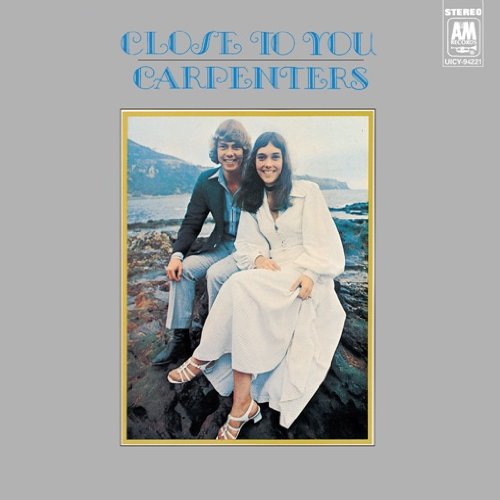
When I was five, I spent too much time with my ear to my parent's stereo, staring at the cover of The Carpenters' debut album and listening to a sweet voice sing "We've Only Just Begun".  Sorry, Mom, you’d been replaced by Karen Carpenter. My bride, my wedding song.


Somewhere during childhood, I gained a sense that marriage was for Other People. This group included bowtie haters, but I still sensed something was amiss. At weddings, I’d try to picture myself waiting at the altar for a bride to walk the aisle following a teary flower girl, either unaccustomed to all the attention or distraught over that fact that several roses had had their petals needlessly plucked. (Okay, it was wrong to impose my thought on a little Melody Cunningham.) I couldn’t imagine some woman in a veil becoming my wife. I had vague notions of feeling unworthy.

In adolescence, I fought to keep new notions vague. If you’d have told me that someday two men or two women would have the right to marry each other, I’d have said, “Inconceivable”. I was beginning to fixate on the “two men” thing, but survival was my highest aspiration. Based on a Texas Monthly article I’d read while attending high school in East Texas, I would have though it more likely that I’d be severely beaten or shot to death by drunken vigilantes.

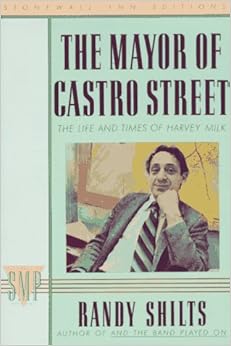
At twenty-two, I’d just finished reading The Mayor of Castro Street: The Life and Times of Harvey Milk by Randy Shilts. I’d bought a second-hand copy at a bookstore in Dallas and dared not look the clerk in the eye. It was an emotional read and it confirmed that murder was more likely than marriage. The AIDS crisis and Shilts’ subsequent book, And the Band Played on, led me to believe that, if not by murder, an early death was still far more likely than a wedding day.

If at any point during my eight years in Dallas/Fort Worth you’d have told me that people would create a hashtag—A what?!—saying “LoveIsLove”, I would have said, “Inconceivable.” From what I gathered, being gay was only about sex. Sinful, dirty, perverted sex.

If you’d have told me during my five years in Los Angeles when I’d make regular trips into West Hollywood to find “my kind”, that gay men could love and be supported by a majority of Americans for being themselves and indeed for being marriageable, I’d have said, “Inconceivable.” As for tweets and rainbow-hued Facebook profile pics—again, what?!—I’d have said, “Inconceivable.”

And yet here we are. 2015. A long, slow process in some respects, but a whirl of mindboggling change when I step back. It is true that a younger generation of men may take their rights to love, marry and just be for granted. And I suppose that’s as it should be. That’s what we worked toward. In another generation, I hope being gay and gay love will be entirely normalized. No “gay love”, just love.

Whew. The talk is of acceptance, not just tolerance. And, yes, the change is remarkable. I am still of a generation that remembers otherwise. Being shunned for so long has had a major impact and continues to define who I am. But I feel the excitement and gratitude. I hadn’t dared to dream that what should be would be. It was inconceivable.

Until it wasn’t.

Thursday, June 18, 2015

GONE GAY

Nearly three months back in the city and I don’t have much to blog about. All those gay opportunities? All that gay exposure? Not so much.


The city’s changed. Most have. Gay ghettos aren’t what they used to be. I can’t walk down Davie or Denman Street and awkwardly attempt to make eye contact with a stream of gay men going to and from the gym. There are still plenty of people, but the gays are gone. They no longer travel in packs in the West End.

And, yes, I know that’s a good thing. Generally speaking, it’s awesome. We can feel comfortable living anywhere in Vancouver or in the suburbs. We are accepted. Hurrah.

It’s funny though. A loss comes with the gains. Gays are not an inherently visible minority. As we pushed for rights and protested discrimination, we strove to make ourselves visible. I remember joining in the chant “We’re here, we’re queer, get used to it.” Twenty-some years ago, I had an earring in my left ear and a pink triangle on my car bumper. See me. See my gayness.

And now, as I walk, I wonder, Where have all the gays gone?

Are we invisible again? Is that progress?

I think I’m supposed to say I’m more evolved. Don’t see my gayness. See me as a whole person. I’m a writer, a vegetarian, something of a fitness fanatic (maybe without the results for you to see that!). I’m an educator, a solo traveler, a literacy advocate, a quirky dreamer who gets lost in nature (figuratively and, unfortunately, literally).

But I am still gay. And it still matters. Try to make a list of what you are in terms of roles, not characteristics. Notice how gay keeps popping up even as you try to prove how you are so much more than that. Gay still defines us, at least in part. For those of us who grew up before society’s enlightenment, our gayness may define us more than it should have. We often fought our gayness before we fought for it. We weren’t instantly accepted or even tolerated. The gayness created a divide as well as a uniting force. (Hello, ghetto.) It weighed on us more. And despite the radical differences between then and now, our past doesn’t just fade away.

So as I walk the streets of Vancouver—I do everything I can to keep the car in park—I don’t see people like me. Not in that way. In some respects, that brings relief. I don’t have to look good when I go to the grocery store. I can wear the t-shirt I should have tossed five years ago. (Okay, ten.) But there are days when I miss it. I miss the camaraderie. I miss the glances or, more accurately in my case, the missed glances. I miss the hope that I might run into my future longtime companion (yes, it’s “husband” now) while trying to decide between HĂ€agen-Dazs and Ben & Jerry’s.

We’ve gained acceptance and then dispersed. We’ve abandoned the bars and taken to Grindr. Yes, the app can tell us we’re not alone as we walk the streets. But, as I understand things, it simply announces who’s horny. This is what we fought for?

Perhaps because I am single and because I don’t shop on Grindr, I still would like to know I’m not alone in the Vancouver crowds. Show yourselves, guys. A simple nod will do, a sign that says, “Me, too.” And if you’re single and you see me in the frozen foods aisle, let’s talk—and eat—ice cream. I’d love the company.

Wednesday, June 12, 2013

THE MUSICAL ROAD TO GAY ACCEPTANCE (Part V)


I began this “Musical Road” thread on the blog because of the current song “Same Love” by Macklemore & Ryan Lewis featuring Mary Lambert. I first heard the song on YouTube two months ago and tears rolled down my face sixty seconds in as Ben Haggerty aka Macklemore shared that he thought he was gay in third grade. Frank Ocean opened a door or two last year with a blog post about his first love being a man, but Macklemore’s put the quest for equality directly in a hip hop song.


Macklemore is not gay which may make his plea and his perspective more powerful in hip hop music, a genre where homophobia has been common. In the song, he references his gay uncles. He tells Entertainment Weekly in the May 31/June 7 issue: “As a straight male, how do I write a pro-gay song? I struggled with that for a while and then I got it: Just talk about my own perspective and experiences growing up.”

Macklemore & Ryan Lewis have the two biggest singles of 2013, with “Thrift Shop” and “Can’t Hold Us”. This provides them a platform to ensure their message is heard by the largest possible audience. “Same Love” is yet to be released as a single, but radio stations have begun playing it at the request of listeners. Moreover, the video has more than 45,000,000 views. Even before the single’s release, the song is currently at Number 65 on the Billboard Hot 100 and, according to Wikipedia, has reached Number 1 in Australia and New Zealand. The impact of this song has the potential to be huge.

Watch the video, which celebrates a first kiss, a glorious leap of faith and the wedding of two men. The video also captures the lifetime of love between the men, lingering in the final moments with a close up of them holding hands at the end of one’s life, the wedding rings a prominent symbol of the love they shared.

This same video shows the struggles along the way, featuring an adolescent trying to find his place in a game of Spin the Bottle and at a dance. There is the gay slur two men face when walking hand in hand down a street and also the apparent rejection when one brings his partner home to a family dinner.

What makes the video more impressive is the fact it was conceived of and co-directed by Ryan Lewis (along with Jon Jon Augustavo), making the project a fully shared work between musician and producer.

The lyrics follow:

When I was in the third grade I thought that I was gay,
'Cause I could draw, my uncle was, and I kept my room straight.
I told my mom, tears rushing down my face
She's like "Ben you've loved girls since before pre-k, trippin' "
Yeah, I guess she had a point, didn't she?
Bunch of stereotypes all in my head.
I remember doing the math like, "Yeah, I'm good at little league"
A preconceived idea of what it all meant
For those that liked the same sex
Had the characteristics
The right wing conservatives think it's a decision
And you can be cured with some treatment and religion
Man-made rewiring of a predisposition
Playing God, aw nah here we go
America the brave still fears what we don't know
And God loves all his children, is somehow forgotten
But we paraphrase a book written thirty-five-hundred years ago.
I don't know.

And I can't change
Even if I tried
Even if I wanted to
And I can't change
Even if I try
Even if I wanted to
My love
My love
My love
She keeps me warm
She keeps me warm
She keeps me warm
She keeps me warm

If I was gay, I would think hip-hop hates me.
Have you read the YouTube comments lately?
"Man, that's gay" gets dropped on the daily.
We become so numb to what we're saying
A culture founded from oppression
Yet we don't have acceptance for 'em.
Call each other faggots behind the keys of a message board
A word rooted in hate, yet our genre still ignores it.
Gay is synonymous with the lesser
It's the same hate that's caused wars from religion
Gender to skin color, the complexion of your pigment
The same fight that led people to walk outs and sit ins
It's human rights for everybody, there is no difference!
Live on and be yourself.
When I was at church, they taught me something else
If you preach hate at the service, those words aren't anointed
That holy water that you soak in has been poisoned.
When everyone else is more comfortable remaining voiceless
Rather than fighting for humans that have had their rights stolen
I might not be the same, but that's not important
No freedom till we're equal; damn right, I support it.

(I don't know)


We press play, don't press pause.
Progress, march on
With the veil over our eyes
We turn our back on the cause
Till the day that my uncles can be united by law
When kids are walking 'round the hallway plagued by pain in their heart
A world so hateful some would rather die than be who they are
And a certificate on paper isn't gonna solve it all
But it's a damn good place to start.
No law is gonna change us
We have to change us
Whatever God you believe in
We come from the same one.
Strip away the fear
Underneath it's all the same love
About time that we raised up.

And I can't change
Even if I tried
Even if I wanted to
And I can't change
Even if I try
Even if I wanted to
My love
My love
My love
She keeps me warm
She keeps me warm
She keeps me warm
She keeps me warm
Love is patient
Love is kind
Love is patient
Love is kind
(I'm not crying on Sundays)
Love is patient
(I'm not crying on Sundays)

Love is patient
Love is kind

Thank you, Macklemore & Ryan Lewis!

Sunday, August 5, 2012

CHICKEN SQUAWK

I received considerable feedback on Twitter and on the blog after posting “A Game of Chicken” on Friday.  The comments are so greatly appreciated as I have had no one to talk with about this issue.  I invite you to read the post, but here it is in a nutshell: 

I learned from a Facebook entry that my brother’s family attended “Chick-fil-A Appreciation Day” and I wondered what my response should be.  Ultimately, I decided to leave well enough alone.  I would not be able to enlighten them and my mother, caught in between, would be the one to internalize the family rift.  Not worth it.
I thought blogging about the matter would help me move on.  How naĂŻve.  I let things fester.  Ignoring the issue was not the answer.

I logged back into Facebook.  Foolish move.  Like peeking under a Bandaid to be icked out all over again.  My chest tightened again.  My sister-in-law’s previous entry was a call out for chair donations for her church.  I thought of writing, “Ask Chick-fil-A.”  It made me smile, but I refrained.  I returned to the inciting entry:  only too happy to support them again today!” 

Enough! I thought.  I have put up with this for twenty-four years since my brother met this woman and he became an extreme Baptist.  My family has quietly tiptoed around my brother and sister-in-law all this time.  My mother gets mad when I count the “God” references in their annual Christmas newsletter.  (I am not exaggerating when I say God makes dozens of appearances.)  We all felt homeschooling their children would create a sense of isolation and deny the kids chances for social interaction, exposure to diversity and opportunities in sports.  (My niece knits.  My nephew plays piano.  They both participated in State Bible Drill competitions.) 

I once tried to bond with my sister-in-law, striking up a conversation after seeing her reading a book.  “Christian mysteries are my favorite,” she said.  Yes, apparently it is a genre.  I suppressed a wave of sarcastic thoughts and poured myself a rum and Coke as my mother frowned at me.  We’re not supposed to drink in front of them.  Don’t let them think of our Episcopalian family as heathens.

But, the thing is, we are heathens in their eyes.  I am, for sure.  Any recitation of my good deeds would be pointless.  Hell awaits.

Why is it that they can live so openly as they believe and I, to spare the family, must shield them from a basic part of who I am?  Family harmony is a complete sham.  I have avoided contact with my brother and his family.  Maybe I am being unfair.  I have made my own assumptions.  I have withheld the truth.

I typed a Facebook reply:  “This hurts so much.”  I stared at the screen, hands shaking.  Yes, I can be very melodramatic.  I erased the words.  Why make a public statement on my sister-in-law’s account?  Instead, I emailed my brother.  The text follows:

Hi Brother’s Name,

I read sister-inlaw's Facebook post about going to Chick-fil-A and I am shattered. To be fair, I have never officially come out to you, but it should come as no surprise. That your family should be against gay marriage is also no surprise.
 
Sometimes I think things were much better before the days of Facebook. I do not need to know certain things and I didn't feel you needed to either. After reading the comment, however, I cannot let you pretend that you do not have a gay brother. So sorry that I do not fit within your "family values", but I am who I am. I do not need your prayers or any talk of loving the sinner, hating the sin. I got enough of that living in Texas and that's a big reason why I left.

The rest of the family knows I am gay. You should, too. However you choose to regard that is your own decision.
 
The message was sent Friday afternoon.  More than forty-eight hours later, I have received no reply.  I don’t expect one.  Still, I am glad I spoke up.  I am tired of assumptions and censoring myself.

I did not attend Pride celebrations in Vancouver today.  I don’t need to.  A stronger sense of pride lives within me.

Friday, August 3, 2012

A GAME OF CHICKEN


I suppose I boycotted chicken establishments twenty-seven years ago.  KFC, Popeye’s, Chick-fil-A,...it doesn’t matter.  I have never wavered since deciding to become a vegetarian.

Chickens, however, have become political pawns.  The outcry isn’t over how they are raised.  Instead, a chicken chain is the latest battleground for gay marriage.  Who’da thunk? (And wouldn’t “Church’s Chicken” have seemed the more likely proselytizer?)

Corporations have been making increasing forays into social politics.  Indeed, many have come out as gay friendly.  Sometimes it is a basic employment decision.  If the company is big enough and extends benefits to same sex partners, it is a newsmaker.  Some go further, participating in Pride celebrations and sponsoring other GLBT endeavors.  I have always applauded when corporations take a political stand—a human rights stand, if you will.  When they take the right stand (er, LEFT stand), of course.

It should come as no surprise that a corporate head should have a different opinion than me.  Chick-fil-A is a Georgia-based company, founded by a devout Southern Baptist.  The business is not open for business on Sundays.  Its express corporate purpose is, in part, "To glorify God by being a faithful steward of all that is entrusted to us."  (If chickens could talk.)

I am not shocked that company President and COO Dan Cathy recently publicly stated he supports “traditional family” and warned that “we are inviting God's judgment on our nation when we shake our fist at Him and say, 'We know better than you as to what constitutes a marriage.  I pray God's mercy on our generation that has such a prideful, arrogant attitude to think that we have the audacity to define what marriage is about."

Ah, yes, let the chicken wars begin.  In the comfort of an enlightened Canada, however, I thought I would watch from the sidelines, shaking my head at the Biblical wrath and quietly lauding the mayors, activists and average LGBT members who speak out and change their chicken sandwich habits.

But then I logged into Facebook this morning and things changed.  It got personal.  One friend from Texas had posted something about long lines at Chick-fil-A and ultimately going to Wendy’s instead.  Long lines at Chick-fil-A?!  Well, maybe in Texas, I thought.  I’d read that the company’s consumer approval rating had dropped dramatically.  But why would my friend even go to that restaurant?!  Her sister is a lesbian.  Corporate values or chicken cravings trumped real family values.

A gay friend in Boise posted something about a Kiss-in to counter Chick-fil-A Appreciation Day.  Both actions predictable.  I smiled as I envisioned same sex couples passionately French kissing.  I imagined the response:  loss of appetite, loud prayers, references to Hell and “hating the sin, loving the sinners.”

And then I saw my sister-in-law’s post.  Chick-fil-A for supper before church tonight. Only 25 minutes in line plus 30 minutes to get food, and such a spirit of joy and happiness with the beyond max occupancy crowd! Chick-fil-A has long been a favorite of mine, so only too happy to support them again today!”  She later added another comment:  Just saw our family on the news tonight--standing in line outside Chick-fil-A!!!  And then my 19-year-old niece:  “Whoa seriously? We were on the news?

My chest tightened, my hands shook.  The pride, the excitement,...I was repulsed.  Yep, this is personal.  In the pre-Facebook days, I would be blissfully ignorant.  I could say I long for the smiley face happiness of the ‘70s, but there were no gay rights then.

Of course, I should not be surprised by the posting.  My brother and sister-in-law are evangelical Southern Baptists.  Their children have been home schooled.  My brother spends his vacations building Baptist churches in the South.  Because there aren’t enough.  My sister-in-law refused to let my niece and nephew read my children’s novel when it was published because I misused God’s name.  (Can’t recall specifically, but I think there is a spot in the book where one of the characters says, “Oh, my god.”)  This is the family that sent me the video “How to Be Saved” as a Christmas present one year.  (To be fair, my Catholic sister got the same “gift.”)  My niece’s Facebook entries are usually biblical quotes.  I could go on and on and on. 

My immediate thought was to “unfriend” my sister-in-law.  Ha!  Take that!  Then I thought of posting a comment.  “So disappointed.  Seems corporate allegiance trumps actual family.”  I passed on both options.  Next idea?  Send my brother an email.  Yes, he had been there, too, likely in the driver’s seat.  Gotta get me some holy chicken. 

And then I thought of my mother.  She’s the one who tries to keep the family together.  She’s the one with the chronic sleep problems, the constant worrier.  I will not have an impact on my brother or his family.  We never talk on the phone.  I sent him a three-sentence Happy Birthday email last month, with the last sentiment phrased as a question, inviting a reply.  Nothing.  If it so happens that we both plan to go to the family cottage in summer, I make sure my stay does not coincide with his.  Last time our vacations overlapped, I didn’t like waking to see an apparel line of Jesus t-shirts every morning.  (Seriously.)   I see him once a decade, at most.  When my parents celebrated their 50th wedding anniversary two years ago, my sister-in-law noted it was the first time in twenty-one years we’d all been together.  And we’re a small family! 

Full disclosure here:  My brother and his family are the only relatives that do not officially know I am gay.  I haven’t told them and I am certain no one else has.  I wanted to maintain occasional contact with my niece and nephew, thinking they may become more enlightened later in life, if they ever stray from Baptist influence.  (It’s looking less likely as my niece just finished her first year at a Baptist university.)  Otherwise, I think the rest of the family thinks, “Why bother?”

And now a game of chicken leaves me questioning everything.  If I wanted to act solely for myself, I would comment on the Facebook entry, unfriend AND email my brother.  So satisfying.  My mother will be the one to suffer.  I have caused her much grief in life as the stubborn, wilful middle child, the one my father tiptoes around.  I have already written my brother off as much as possible without the family drama that comes from making it official.

The hurt I feel this morning surprises.  My gut says nothing good will come in passing on the hurt to someone else.  Maybe it is time for me to tune out the self-righteousness and take the higher ground.