Showing posts with label AIDS Quilt. Show all posts

Friday, March 29, 2024

OH, FARRELL (Part 2 - A Chance for a Friendship to Deepen)


This is Part 2 of my memories about a gentle man, Farrell Cain, with whom I became good friends while I was still hiding in the closet as a gay man in Texas. (I encourage you to read Part 1 first. I split them up because, as a single piece, it runs a tad long.) 

Farrell had his own closet. Both of us had grown up with the church as an influence and, in '80s Texas, the closet felt safe, if a little smothering. It took me moving to California for us to finally come out to one another, not via conversation--somehow too risky--but by an exchange of letters. Whew! Not we could grow together, a lifetime ahead of us to build on our friendship.


When you have a friendship you know will last, there is always time. Another conversation, another visit. The gaps don’t matter. You pick up right where you left off. Farrell and I had that foundation. After law school, I moved to Vancouver. We continued to keep in touch, mostly by mail.


In March 1996, I called on his birthday. A woman with a thick drawl answered. Sorry, no Farrell. She’d had the number a few months. I figured Farrell had moved. Back then, most people didn’t have cell phones, Farrell (and me) included, and phone numbers didn’t transfer to a new home. I knew he’d lost his job which hadn’t made sense since he was smart, loyal and conscientious…a model employee. Maybe he found a roommate or got a cheaper apartment. He’d mentioned keeping busy by volunteering at the Dallas AIDS Resource Center to do their bookkeeping.  


Three days after his birthday, I sent him a card knowing the post office would forward it. I ended my note with:

Write me a quick note when you receive this so I know how to contact you.

Take care & please keep in touch.


Two months later, as I checked my mail after a gym workout, on my way to join my new Vancouver friends for coffee, the card sat in my post office box, stamped twice in red: RETURNED TO SENDER. My heart sank. Reconnecting with Farrell would require more effort. Calling directory assistance would hopefully do the trick.


But then, as I sat with my coffee, waiting for friends to get their lattes, I looked again at the envelope. I gripped the edge of the table. I felt the breath knocked out of me. Above where I’d written Farrell’s address in blue ink was a note in a lighter blue ink on one of five red lines from the return to sender stamp: “deceased.” I needed a friend to confirm I was reading things right.


It still stuns me when I look at the notation. How often did mail processors write this? Did they think anything of it? Did they wonder even for a second how the “sender”—that’s all I was as far as they were concerned—would react upon receiving it? Did they assume the addressee was someone far older than thirty-seven? They were just doing their job, working through stacks of mail.


In the spring of ’96, it was common to grab coffee with my gym friends and have AIDS come up in conversation. Several friends and acquaintances from Denman Fitness were HIV+ or had AIDS. Some appeared visibly frailer by the week. Some died. Our regular coffee spot in Vancouver’s West End was THE place for gays to congregate. We jockeyed for outside seating or stools by the window so we could cast our eyes on the men filing in and out or strolling by on the sidewalk. Not a coffee passed without the vestiges of AIDS in view—KS lesions; gaunt eyes; rough, discolored skin; canes for assistance; wheelchairs pushed by a friend or lover. My shock over Farrell’s death didn’t land with my friends. There was a certain numbness by then. So much death required some degree of emotional distancing to carry on, to not succumb to anger and despair.    


I can only deduct that Farrell died of AIDS. It was, after all, going around. It’s what gay thirty-somethings died of. It’s likely the reason he lost his job in conservative, God-fearing Dallas. (Did he lose it or was he too unwell?) It’s why he connected with the AIDS Resource Center. His cards mentioned being restless, wishing he could find a job and feeling financial strain. It shatters me every time I think about what he kept from me. Did he think I was too busy? He'd known I’d volunteered at AIDS Project Los Angeles. Why the barrier? Had self-hate and shame kicked back in?


I don’t know how he died, whether it was at home, in hospice or in hospital. I don’t know if he was alone or had a friend, maybe more, by his side, checking in on him, holding his hand at the end, gently telling him it was okay to let go. 


I have quietly lived with mourning and missing Farrell. As with many of my friends, we always socialized one to one. That’s common among introverts which we both were. The conversations are better, the attention undivided. There was no one to call for answers or to mutually console. 


For years now, I’ve wanted to make a panel to honor and remember him as part of the AIDS Quilt. I’ve researched it, I’ve planned what to put on it: symbols for tennis, the symphony, accounting, the University of Dallas and New Orleans Mardi Gras. I went to a quilting store on Granville Island to get a particular hardy tarp-like fabric for the panel, but they didn’t carry it. That one stumbling block was enough to let a simmering doubt boil over. I have a large button I can’t sew back on my jacket. I have jean pockets with unseen holes that need to be stitched. These tasks are not in my wheelhouse. I’m challenged with even threading a needle. How would I ever create a quilt that looked better crafted than a third-grade friendship bracelet? Anything I stitched together would dishonor rather than honor. Noble idea, but nothing I could execute. Alas, my plans remain pinned by a magnet to the filing cabinet in my office. Seeing his name makes me smile. I honor him, just more privately. Maybe that’s all he’d have wanted.


Every so often, I’d Google “Farrell Cahn” again, as if the greater passage of time would turn up some pre-Internet treasure. Sometimes I’d narrow the search, counterintuitively adding “Louisiana” or “Dallas” or “University of Dallas.” I had to do it. I had to feel like I was doing what I could to confirm the life of someone whose memory I seemed wholly responsible for holding. Maybe an obituary would provide closure. So that’s when he died. Maybe it would mention donating to an AIDS hospice. Maybe friends, family or even a longtime companion would be included. Would I reach out to his estranged sister a quarter of a century later? 


After each fruitless Google, I was left with one frustrating conclusion: ordinary people whose entire lives were BGE (Before Google Era) disappear without a trace. 


The only Farrell Cahn to be found on the worldwide web was a physician’s assistant in Burbank, California with a different first name but for whom Farrell was the middle name. But then a Facebook page came up for the University of Dallas. 


My Farrell! Apparently, the one and only Farrell Cahn. 


It took a fraction of a second to glimpse the picture, for it to register that it was a really bad photo and then to realize how precious it was. I burst into tears, an uncontrollable wail, something guttural surging from emotions I hadn’t fully processed over a quarter century. I was inconsolable, overwhelmed by grief, pain, sadness mixed with joy and relief. I found you, Farrell. I found something that goes beyond my personal memories of you. Twenty-first century, this is Farrell Cahn, an extraordinary ordinary man. Look at him bent over, looking up at an unseen photographer as he puts something in a trash bag.  


The Facebook post was from April 29, 2021: 

#fromthearchives Earth Day was last week. Did you help make our campus more beautiful? Farrell Cahn (BA ’80) definitely helped clean up campus in this picture from 1979. Follow in his footsteps and help make our campus a better place.


Farrell the activist? Farrell the environmentalist? Farrell the good guy. That’s something. That’s everything.


Tuesday, February 9, 2021

A DAILY MEMORIAL


Sometimes it’s all I can do to breathe shallowly. This is one of those moments. My laptop is having some issues and, no, the breathing issue is not about that. Not directly. It’s been on its last legs for a year and a half now and, although I backup my work regularly, I know I should switch to the new one I finally bought last month. It would be worth it just for the fact I’d have an “e” key that actually works. (On this device, I have to copy an “e” from existing text and then press Control-V on those rare occasions that I use an “e” in my writing—gosh, only fourteen times in this sentence.) Last night, my laptop once again shut down unexpectedly so I took it as a sign that I was done with writing for the day. I braced this morning, powering it up again. Would it work? Would all my open documents pop back up? Would the sixteen open tabs on my internet browser still be there?


Yes, the laptop is functioning. None of my documents show up, but I’d saved all my work and I just have to open them up again. When Firefox asked if I wanted to restore my last session, I clicked the button to do so but, alas, it retrieved the open tabs I’d had from last October instead of from last night. That’s where the shallow breathing comes in. Not because I’ve lost some needed sites that had been open so long that they don’t show up on recent history search—I can search anew or just move on—but because one of the tabs staring at me anew is about an actor who, as I read it with my sleepy eyes at six o’clock this morning, “succumbed to AIDS.” Of course, I knew his fate. I’d stumbled upon the actor and researched him last September. Still, it’s a jolt each and every time I read about someone dying of AIDS, especially when the coffee hasn’t kicked in. All that gone-too-soon loss of life. I’ll never get past that. It would be easier if I did, but I don’t want to. Like veterans who served in war, I feel a duty to remember those who didn’t survive the AIDS crisis. Never forget. Even as I sense that so many have done just that. Even as I wonder if queer people who are younger than thirty have any sense of what those years were like.


R
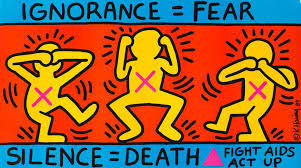
eminders of AIDS are all around me as I sit in my home workspace, a windowless room that I suppose was intended to be a dining room or maybe a walk-in closet. Just to the left of my laptop, at the edge of my desk are three playful block figures copyrighted by the Keith Haring Foundation. Think I bought them years ago in a shop in Portland. One of those charming spots filled with eclectic trinkets that will never cover the rent. Haring’s creations are always colorful and fun, the figures captured in motion. They make me smile. I think I bought these blocks to remind me to be playful with my writing (maybe not at this particular moment) and to celebrate simple things like an impromptu dance or a chance to pet and perhaps calm a barking dog.


But Haring’s art also represents my gay identity. I used to have a Keith Haring backpack, a look-at-me-I’m-a-proud-fag symbol. People would stop me in the streets of Amsterdam or at a hip cafe Seattle and comment on it. “Keith Haring, right?” Yes, yes. They’d smile and offer a knowing nod. Translation: You’re gay. It was my old-school version of Grindr. Gay man two metres away. (That’s what Grindr does, right? I’ve only seen it while peeking over a friend’s shoulder years ago as he looked at his phone while we were in a gay bar in West Hollywood. “Oh, my god, everyone in here is on Grindr!” he said with a sense of excitement I found odd. As with most technology, I didn’t get it. This was a gay bar...why did we need an app to tell us that the guys around us in too tight t-shirts or no shirts at all were queer?) Alas, my backpack had its glitches as a Grindr substitute. The people who stopped and commented were always artsy women. I suspect the gay men always crossed the street as I approached.


My beloved Keith Haring backpack is long gone. One morning, as I was writing in a regular cafe—sigh, I miss writing in cafes—my backpack disappeared from the foot of the chair where I was sitting. A homeless person who’d come in ostensibly to use the restroom brushed past me and took off with it. I suppose he needed it more than I. Maybe he even got lucky a time or two.


I’ve always loved that Haring’s art is so accessible. He knew this and used this to create iconic messaging during the AIDS crisis, making people look when they preferred to look away.
Haring died of AIDS-related complications in 1990, thirty-one years ago this month, for him an entire lifetime ago since he was thirty-one at the time. Googling that fact right now feels like a sucker punch to the gut. I’m winded. Again, short breaths. That’s all I can manage.


To my right are four Post-its, their non-sticky parts rising up from my desk surface. A small blue one has the name of the actor/director who’d succumbed to AIDS. I wanted to write a blog post about him. I might not have noticed my scribbled note for another half year. For me, I see a Post-it for a day, maybe two, and then it loses its intended powers of reminding. Little thoughts, things that spark a creative idea in the moment, can quickly be forgotten. Not so, the big things. Like AIDS itself.


There are also a half dozen notes written on torn off pages from three different notepads—a note about querying, a writing to-do list from a month ago (the items still not done), an idea for a novel that I must have thought was brilliant when I jotted it down but now it seems like not much at all. I keep it in the open, hoping that, whatever sense of genius I had felt when I madly wrote it, circling words and adding explanatory arrows (which now explain nothing), will miraculously return on a later glance. Not today.


One of the other pages lists possible ideas I could write about for a regular essay column about relationships in an American newspaper. The first idea is about Stephen, my assigned buddy when I was a volunteer with AIDS Project Los Angeles (APLA). Had he not died of AIDS-related complications at twenty-nine in 1992, he’d be fifty-sev
en today. Sweet, sweet man with big, big dreams. Dreams unfulfilled. The second essay idea on the list is about my dear friend Richard whom I met as an APLA volunteer, who talked me out of wanting to commit suicide when my first love cheated on me with a friend of mine and these two dickheads decided they wanted to make a go of things. Richard often marveled at how he made it through the AIDS crisis as so many friends and lovers around him died. Sadly, Richard died five years ago of brain cancer, still much too young, but he knew the extra quarter century he got was a blessing.


On the side of my four-drawer filing cabinet—yes, I still have such an outdated storage device—is a much crumpled note tacked up with a magnet. It lists background facts and passions of my friend Farrell, my tennis and margarita pal from my days in Dallas. I remember the time I showed up on court after margaritas—happy hour with the nuns I worked with—and, after five minutes of hitting the ball, he just stood on the other side of the court and laughed. Apparently, margaritas are indeed an energy drink, but in all the wrong ways. I dutifully retrieved the two cans of balls I’d managed to send over the fence and we sat and talked on a bench until it got dark. Back then, I didn’t know Farrell was gay and he didn’t know I was. He came out in a letter after I’d moved to Malibu, sensing a coldness when he flew out for a visit and concluded that it had to be because I’d figured out he was gay. We are so sensitive and so capable of misreading signs when we’re closeted. That coldness was law school stress that I stupidly hadn’t shaken, a nice visit unduly compromised.


That crumpled up piece of paper is supposed to help me design an AIDS quilt panel in m
emory of Farrell, the sizing and required materials written on the back. He died in 1995. I found out when a card I’d written to him was returned unopened to my address in Vancouver, a red postal stamp reading: DECEASED. I hadn’t put things together until then and Farrell didn’t share with me. I knew he’d lost his accounting job in Dallas, which could only have been due to illness or discrimination. Farrell was the most dependable person I knew. He’d shared that he was volunteering with the Dallas AIDS Resource Center. That’s the last I heard from him. A very reserved, proud man, I fear Farrell died alone. He’d been adopted and all his relatives in New Orleans had predeceased him. I don’t really have the means of making a quilt. I don’t have the craft gene. I don’t even have the holding scissors safely gene. This project intimidates me. The desire is there along with the sense that, if I don’t remember and honor Farrell, no one will.

Yes, AIDS is still all around me. The reminders are small and quiet. Some days, I don’t even see them. On other days, like today, I’m hit first thing and I know its shadow will hang over me until bedtime.


Small breaths. I’m so lucky I can do just that.


Tuesday, December 1, 2015

REMEMBERING

My first thought on World AIDS Day was, Let this not be about Charlie Sheen. The media likes to make things topical and timely. But pop culture needn’t drive such a significant day, a time to reflect on lives lost far too soon. Needlessly. Painfully. All too swiftly.


There was a time when the pop factor mattered. Rock Hudson. Freddie Mercury. Magic Johnson. They helped “normalize” HIV and AIDS by shining a paparazzi-driven spotlight on the crisis. Pedro Zamora educated young people about AIDS, talking openly about his diagnosis on “The Real World” during what I believe was the reality series’ finest season. And for a while, Entertainment Weekly ran “The Faces of AIDS” on an annual basis, showing how the death toll impacted the industry. It was a somber, compelling statement, part tribute, part tragic reminder of the personal and creative toll.

Movies like “Philadelphia” and plays like “Angels in America” provided memorable characters to show the public the struggles that came with AIDS and to provide those of us closer to the crisis another means of grieving. Still, two works continue to impact me to this day as I reflect on the fears and frustration I felt throughout the AIDS crisis: (1) Randy Shilts’ And the Band Played On which awakened me to the magnitude of the problem and the infuriating politicking that interfered with sound public policy and research efforts, and (2) “Common Threads: Stories from the Quilt”, the Oscar-winning documentary on The NAMES Project AIDS Memorial Quilt which achingly told the stories of loved ones lost.

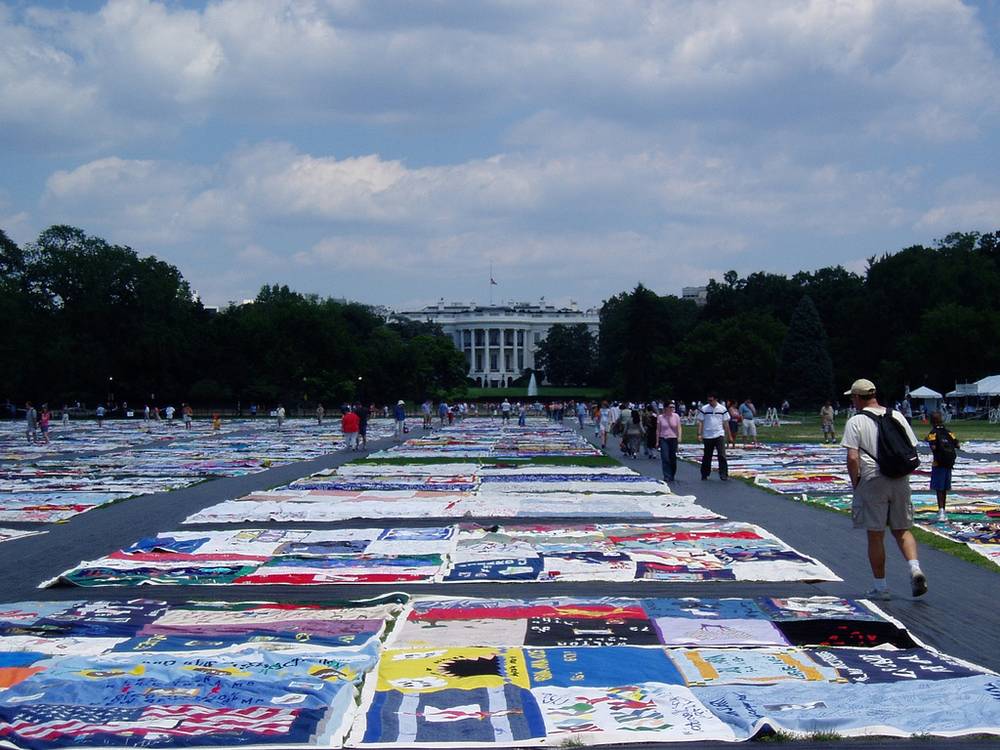
Today, as I stop to think about Stephen and Farrell and Don and Jose and Steve and Greg and others whom I knew who died from AIDS, I wish there were a public initiative for yet another grand-scale unveiling of the AIDS Quilt. Parts of the quilt tour the U.S. during the year and I am not sure that the 48,000 panels can be displayed in one setting. Let it be shown in large sections in public parks and stadiums on this day. The individual panels were meant to be displayed as a collective. While we marvel at medical advances today, people need to be reminded of the scope of the devastation from AIDS and its continuing destruction in parts of the world.

Today is a day to love, to honor and to remember.

Friday, July 17, 2015

HAVE WE FORGOTTEN?

I cannot forget.

The AIDS crisis happened. Millions of people died. Some of them I knew.

Farrell.

Stephen.

Don.

Steve.

Greg.

AIDS overshadowed my coming out process. Fear of death kept me from any period of sowing my wild oats. There were options, of course, but I always read “safe sex” as safer sex. And I was never much of a risk-taker.

I’d first heard of it watching a report by Geraldo Rivera on ABC’s “20/20”. At the time, it was called GRID, Gay-Related Immune Deficiency. Some rapid-moving disease was afflicting gay men, radically transforming their appearance and killing them. I watched the report while sitting uncomfortably alongside my parents in my family’s den in East Texas. At the time, I was conflicted and closeted. Concrete walls. Dozens of padlocks. I’d told my college roommate that I’d decided to be celibate for reasons I bumbled through. College and celibacy made for an odd cocktail. Innately, I was a survivalist. This was Texas. To be gay was to be a sinner, a pervert, a future pedophile. (It was a package deal.) And now it looked to be the target of a new holocaust.

It would not be much of an overstatement to say AIDS was always on my mind from 1985 to 1995. The first gay book I ever read was E.M. Forster’s posthumously published Maurice (1971). (Forster finished the first draft in 1914 but deemed the topic too taboo for publication.) It was a magical read that captured the fear in acknowledging my homosexuality but also the hope that love could come. The second gay book I ever read and the first I ever owned was And the Band Played on: Politics, People, and the AIDS Epidemic by Randy Shilts. This read offered no hope, only frustration, deep sadness and intense anger. I still tear up just looking at the cover of a book that informed me but also helped embolden me to remove one or two of those padlocks. My copy of the book found a place on a bookshelf instead of finding cover in the sock drawer.

I read every article I could find in newspapers. I scanned pamphlets from the Dallas AIDS Resource Center. I followed television reports and eventually began looking in professional journals. There seemed to be no hope in terms of treatment. If there was any feel-good element at the time, it was that AIDS was experiencing its own coming out. Anytime a politician spoke the word AIDS, it made headlines. Researchers began sharing findings at global conferences. And sometimes a prominent person had the gumption to tell Jesse Helms to shut up. It seemed there were little battles to be won in what was still overwhelmingly a lost cause.

It’s weird to think that AIDS helped me come out. It got me out of the bars in West Hollywood and allowed me to establish my first gay friendships that didn’t evolve from failed pickup lines. I even found love for the first time in my life after being introduced at an AIDS volunteer appreciation gathering. My AIDS buddy group facilitator dragged me onto the dancefloor, told me to stay put and then dragged out a certain AIDS Project Los Angeles employee. “You two should get to know each other.” And so we did.

At some point in the mid- to late-1990s, I began reading less about AIDS. At first, I’d skim the first paragraphs of an article, then I’d just glance at a headline. There had been some hopeful signs, but I’d hit AIDS overload. And then I received the news of my Dallas friend Farrell’s death through a Return to Sender stamp on a returned card I’d mailed him shortly after my move to Vancouver. Reason for Return: Deceased. He’d never dared to confide in me that he had AIDS. Living in Texas, the stigma remained too great. I think that’s when hope died within me. This extraordinarily kind, gentle soul, ultra-conscientious and responsible, a man with no family and few friends, likely died alone at the ripe old age of thirty-five. There was no answer to “Why?” I pulled away.

And almost at the moment I stepped back, real progress started to happen. People I knew who were HIV positive stayed like that. They averted what was supposed to be the imminent AIDS diagnosis. I still see them in passing today, twenty years later. No cure, but something that can be managed.

Wonderful, wonderful progress. It’s what we all yearned for so impatiently in the late 1980s and early 1990s and what most of us probably became resigned to not happening. Not in our lifetimes, however stunted they may turn out to be.

Maybe it’s because improvements in managing HIV and AIDS happened over time that there was never a time to celebrate as with the end of a war. It took so long and yet seemed to happen quietly overnight.

For the most part, these are good times to be gay, at least in a growing number of countries. The euphoria and expressions of Facebook support that came with last month’s U.S. Supreme Court decision on same-sex marriage have no doubt made this summer’s procession of Pride Festivals in North America all the more festive. Let us indeed feel the joy.

And, yet, let us remember as well. Like the Holocaust, remembering is somber and many people don’t want to go there. Why do they keep bringing THAT up? According to amfAR (American Foundation for AIDS Research), nearly 39 million people have died of AIDS-related causes and more than a million people each year continue to die. Much remains to be done in less developed areas of the world. But even in places where treatments to manage HIV are accessible, there remains stigma and managing it comes at financial, physical, mental and emotional costs.

I’ve lamented before, but I fear we’ve become complacent. And I sense that the generation younger than us lacks perspective or any real appreciation about the decimating impact of AIDS on gay life and culture. Being back in Vancouver, I can access events that never made it to my rural area. A case in point was the screening of the 2012 Oscar-nominated documentary “How to Survive a Plague” which played at a branch of the Vancouver Public Library two nights ago. I had read about the film when it was first released but there was no possibility to see it. A friend of mine thinks it may have had a few showings in Vancouver shortly after its release. Its total box office take was a paltry $132,055.

I saw a poster for the screening two weeks prior and excitedly photographed it and texted it to a friend. “Want to go?” It took him a day to respond but, yes, he was in. Being a free event, we knew seats would fill early. The day of the screening, my friend went online and learned that tokens for the screening would be given out an hour ahead of time. We were there even earlier. (There proved to be an added benefit as my friend shocked me in saying, “I haven’t been in a library in years.” He did some important sightseeing—“Wow. I thought all the books would be old and smelly.”—while I returned some books and used the internet to post a blog entry.)

With our tokens in hand—Victory!—we grabbed dinner at a nearby Thai joint and returned fifteen minutes before the 6:30 screening. We were the first to claim our seats. To my shock, there were less than fifteen people in attendance when the documentary rolled. (Three teens with fast food sodas popped in half an hour later, talking loudly and shuffling about. Two ducked out after three minutes; one stayed for a solid ten.)

It’s an important film, one that chronicles the efforts—some might say antics—of ACT UP and offers insightful perspective from those in the archival footage who indeed survived. It also shows us real heroes—people like Mark Harrington, Iris Long and Peter Staley. And it brings back the always agitated Larry Kramer—the world needs Larry Kramers, as polarizing as they may be—and Dr. Anthony Fauci, a man whom I’d once pinned so much of my hope on facilitating an early breakthrough. It reminds us of the AIDS Memorial Quilt, now warehoused in Atlanta, and not displayed in its entirety since, shockingly, 1996. Wouldn’t this be a fitting year to bring it back into public consciousness?

Where were all the other viewers? Maybe there’s a way to download it online. I could only find trailers for it on YouTube. (And how sad that as I began to type the film’s name, the prediction device offered “How to Survive a Zombie Apocalypse” first.) Clearly, the library expected a big turnout as did I. It seemed like a sad joke when the librarian collected our tokens before pressing Play on the laptop. I suppose I’m becoming an elder statesmen, fretting that the young will be unaware of our past, but I am also alarmed about my contemporaries. I don’t see them at AIDS Walks and they were no-shows once again. (The other audience members seemed to be straight couples and an emotional sixty-year-old woman sitting behind me who frantically flicked some clicking device each time the film reached an intense moment.) It’s a gripping movie that has played to too few.

“Plague!” Larry Kramer shouts at one point. “Plague! This is a plague!” More than 6,000,000 had died by the film’s focused period ending in 1995. Holocaust numbers. There are active groups that help us remember the ravages and injustices of wars past. What about the AIDS crisis? Are there not others who feel it is critical that we remember, that we honor and that we pass on our own narratives?

It is my sincere hope that others connect forget as well.


Saturday, November 30, 2013

LIVES LOST


I fear we’re forgetting.

In the 1980s and 90s, AIDS ravaged gay communities, created doorknob hysteria and gave the public a medical excuse to shun homosexuality. It was the time period in which I came out—a time of fear and hatred. More significantly, it was a time when thousands of gay men died far too early, when a cliché like “only the good die young” became maddening. Nothing could soothe or help make sense of the tremendous loss.


I want the men—and women and children—who died from AIDS-related conditions to be remembered, their stores to endure. That is why the AIDS Quilt meant so much—loved ones reflected on the highlights of a life lived and honored that individual with a tapestry sewn together while working through their own grief. I remember sitting alone in an L.A. movie theater, watching the Oscar-winning documentary “Common Threads: Stories from the Quilt” and being so distraught I couldn’t leave after it ended. Beautiful people gone. The haunting Bobby McFerrin soundtrack plays in my head as I recall the pervasive sadness (and the lighter moments) that make the film so vivid to me even now.

But the film’s threads were only snippets of a few of the people who died. So many small and big moments could not be shared in an 81-minute film. Years after a person dies, a loved one will continue to lament about moments that cannot be experienced together and he or she will feel intense guilt when realizing a whole day may have passed without thinking about the deceased person. Recalling the face, the mannerisms, the moments becomes harder. Photos provide an infusion.


And yet, just as veterans speak of concerns about the public forgetting the fallen in time of war, the same goes for those of us who lived, loved and lost during the peek of the AIDS crisis. Much good arose from dark times. Anger led to activism and, while some fortified their closets, many stepped out, embraced the (at the time) more in-your-face term “queer” and demanded acceptance and understanding, the stepping stones to today’s unrelenting push for equality.


Still, on the eve of World AIDS Day, I urge younger gays to Google something other than porn, to tweet something not about Miley and to learn more about a generation that watched vibrant individuals waste away in short, yet agonizing months. Find a copy of And the Band Played on by Randy Shilts or David Levithan’s new two boys kissing, read blog posts about World AIDS Day, watch “Common Threads”. Talk to those of us who are older. Ask us to share memories of sweet souls who died despite all the hope and courage they could muster.

By all means, celebrate your life. But, please, take some time to celebrate past lives of people who should still be with us. They still are, of course, if we can talk, share and remember.