Showing posts with label gay characters. Show all posts

Monday, July 10, 2023

"HI HONEY, I'M HOMO" (Book Review)


Subtitle: Sitcoms, Specials, and the Queering of American Culture


By Matt Baume


(Smart Pop Books, 2023)


Once upon a time, I lived in front of the TV set, that big old blocky thing with three main channels and a few others if the TV aerial was having a good day. For an anxious, introverted kid, this was a great form of play, no ball skills required, no need to brush up on and quote hockey stats. I stuck with my imaginary friends who were fleshed out with voices and images inside the box in the den—Peter Brady (a curly-haired middle child like me—and cute too, though I was a little confused about why that mattered), Scooby Doo, Gilligan, a Jeannie in a bottle and, most of all, Mary Richards. The ’70s was a golden TV decade for me. But then, so were the ’80s and ’90s. Television viewing offered safe exposures to humans, along with animated talking dogs, an alien from Ork and a banjo-playing frog puppet. 


Since I ate up TV trivia more eagerly than goals and assists for Guy Lafleur and much (but definitely not all) of my childhood confusion turned out to be about the fact I was a nascent gay, I grabbed a copy of Hi Honey, I’m Homo! Sitcoms, Specials, and the Queering of American Culture when I saw it on display at The Strand’s flagship bookstore in New York City. Even better, its author Matt Baume was scheduled for a book talk the next night. I sat in the front row—unabashedly outing my TV geekdom along with sixty other attendees. 


I’ve now had the time to finish the book, carefully guarding my consumption, limiting myself to a chapter per day. (Funny how my parents never monitored my TV time.) First, a small quibble with the title. I don’t love the main title, but I suppose it’s an homage to family sitcoms and the breadwinning father’s return after a day at the office. It’ll do. The subtitle, however, should be tweaked by deleting “Specials” since the book focuses on a dozen sitcoms, appearing chronologically from “Bewitched” to “Modern Family,” each allotted a chapter.


Baume does an excellent job weaving American political and cultural history from the time that each sitcom ran, to help show how gay references on TV comedies reflected society and, sometimes, were ahead of their time, perhaps even prodding America toward greater understanding and acceptance. If sometimes in the first half of the book it seems a stretch to devote an entire chapter to a show like “Alice” with a single gay-themed episode or “Barney Miller” having a recurring character appear on eight episodes out of a 170-episode series run, it’s because it was that difficult to get any sort of gay content on network television. In addition to gay culture still being closeted everywhere but the biggest cities, there were TV censors, the Family Viewing Hour and grassroots conservative organizations such as the National Federation for Decency that threatened boycotts and pressured advertisers. A television producer invited migraines when flirting with putting a gay character in the cast of “Soap” or by choosing to have a drag character named Beverly LaSalle on three episodes of “All in the Family.” Fortunately, the creators of these shows were committed to being topical and edgy.   


Baume had to make choices that other TV nerds like myself can quibble with. I would have gone with a single episode of “Mary Tyler Moore” over “Alice.” I loved both shows but the MTM depiction is more positive than the “Alice” episode wherein the titular character spins on the notion that gay men are pedophiles as she wonders whether she should allow her son to camp overnight with a gay man (and her macho, seemingly straight diner boss, Mel). I also found Baume’s gay interpretation of an episode of “Dinosaurs,” a show I’ve never seen, to be unconvincing. The Ice Age raptor son is going against parental and societal values by wanting to be vegan. Parallels can be made but there is no evidence the writers were touching on gayness. I believe the show’s writers simply thought it would be funny—and different—to have a hardcore carnivore go against his family and declare he fancied broccoli, but this really seems like standard situational comedy, a teen trying something that wigs out the parents.


I can’t figure out why Baume didn’t include a chapter about the Tony Randall-Swoosie Kurtz sitcom, “Love, Sidney,” which aired forty-four episodes over two seasons from 1981-1983 and, according to Wikipedia “was the first program on American television to feature a gay character as the central character.” (Randall’s Felix Unger on TV’s “The Odd Couple” (1970-1975) also came off as gay to many viewers based on neatnik, effeminate stereotypes.) 


It’s also a mystery why Showtime’s “Brothers” (1984-1989), about three brothers, one of whom is gay, gets short shrift. That sitcom illustrates how the burgeoning cable channels could take more chances which, ultimately, moved the bar for the major networks as well. Furthermore, the entire chapter on “Cheers” feels like a cheap attempt to attract readers being as it was such a ratings success. The show’s gay content is scant whereas another ratings juggernaut, “Roseanne,” was far more gay-friendly, featuring Sandra Bernhard as a bisexual friend and Martin Mull as Roseanne’s boss, Leon, who eventually marries Fred Willard’s attorney character, Scott. (These supporting characters, while groundbreaking, didn’t make up for the fact that neither Roseanne’s sister, Jackie (Laurie Metcalfe), or daughter Darlene (played by lesbian actress Sara Gilbert) weren’t written as queer, but that’s part of the discussion Baume could have fleshed out.) I'm wondering if Baume or his publisher nixed the "Roseanne" chapter since Roseanne Barr has fallen so epically...and not on account of her anthem singing.


One thing I tired of in Hi Honey was all the repetition. The negative depiction of homosexuality on “Marcus Welby, M.D.” appears in four separate parts of the book. An account of people protesting outside the offices of “Soap” is mentioned verbatim in the book’s opening vignette and then a hundred pages later. It seems incidents of repetition are an editorial choice based on an assumption that some readers will skip chapters about shows they didn’t know or like, but this dummies things down (and offers annoying moments) for people like me who opt to read from cover to cover. Rather than harping on “Marcus Welby,” I’d have loved some elaboration on an almost random reference on page 101 about the fact ABC employed an on-staff psychic named Beverly Dean. Yes, things were kooky in the ’70s! 


Sigh. Baume’s book is still interesting for this TV aficionado. When the gay content is more apparent, giving him more to work with, the chapters are much more interesting. The chapter on “Ellen” is furtive ground, even if I wanted more in-depth analysis of the clunky yet earnest season that followed Ellen Morgan outing herself to Laura Dern’s Susan and, via microphone, to other airport passengers. I would have loved a tub of popcorn as I gobbled down Baume’s accounts of “Will & Grace” and “Modern Family.” 


Television has come a long way in its portrayals of queer characters. Perhaps today’s awkward, nascent gay boys have more opportunities to understand their identities by catching content so accessible on phone and laptop screens. 

Friday, August 13, 2021

IT'S TIME FOR ALL CARTOON GAYS TO COME OUT


Time for a bit of fluff for the dog days of August. 

Did you catch the BIG NEWS story this week?

Holy Houdini! Robin’s gay. We’d all heard the rumors and speculation. For some, it even mattered.


But there’s more. Holy knit one, purl two![1] Robin’s going on a date with a guy named Bernard. 


You missed out, Batman.


To be honest, I don’t know much about Batman and Robin. I saw a few episodes of the old TV show. I know the theme song. I’m familiar with Prince’s “Batdance,” which seems like a mistake in his music vault. (Listen and try to convince me I'm wrong.) I saw one of the movies in the mid-’90s with Kilmer or Keaton or Clooney playing Batman. I hated it. More special effects than plot. I’d rather have watched a documentary on bats. Or robins.


My favorite thing about the old “Batman” TV series was when Batman would be called for help and he’d say to Robin, “To the bat poles,” which they accessed through a bookcase that slid open. (See this, but fast forward to 1:57 of the clip.) Cool! More moving bookshelves, please. Maybe put a secret scrapbooking room behind it.


Really, I never lusted over Robin. I never wished he were gay, even as a role model for other superhero sidekicks. To be honest, I don’t marvel over any superhero characters. 


But the announcement that Robin is gay got me thinking about the fictional hand-drawn or animated characters whom I truly wished were gay.


Sticking with superheroes for a moment, I’d be gleeful if the characters played by Hugh Jackman and Ryan Reynolds came out--Wolverine (Jackman) and both Green Lantern and Deadpool (Reynolds). (Thank you, Google.) It’s nothing about what these characters do or what their powers are. Any scenario where Hugh and Ryan are gay makes my fantasies a tad closer to plausibility.


Top of my stop-motion animation list is a character I’ve mentioned MANY times as a lifelong crush: Hermey the Elf from “Rudolph the Red-nosed Reindeer.” That blond hair, that independent streak (even when it’s technically not so), even his challenges in efficiency pertaining to his manual labor output. (I picture him with perfectly clean fingernails, consummately manicured. Hermey accepts differences in others, not hesitating to welcome an outcast reindeer. He’s even got a successful career is in his future. A dentist! He could floss my teeth every night.


In standard TV animation, I’ve mentioned Fred Jones from Scooby Doo, too. Yep, another blond. I’m not sure whether that orange ascot tie really goes with the rest of his outfit. It goes too well with Daphne’s hair and I need her to keep away from Fred. (She and Velma would make a great lesbian couple, right?) Most of us Scooby Doo fans must concede, however, that Fred’s a dull one.


Hell, let’s make Scooby Doo himself gay. We need more out animals, fictional or real. Like those zoo penguins. Maybe Scoobs could hook up with that other Great Dane, Marmaduke, who always struck me as lovably goofy, but then Goofy’s probably goofier. Scoobs could turn to Goofy if the Marmaduke thing doesn’t work out. 


That’s right. Goofy is one of my criteria for a desirability in gay men, gay dogs, straight folks and aliens from Ork.


Sticking with animated animals a moment longer, I always assumed Snagglepuss was gay based on old, stereotypical mannerisms, but among pink cartoon felines, I’d lobby more for a certain suave, clever panther to wave the Pride flag. If pink isn’t a factor, I urge Calvin’s sage best bud, Hobbes, to explore his gay side.


Back to hand-drawn and animated humans:


Linus…Did he ever want to get with Sally? Isn’t Sally a classic fag hag (if that term can be used anymore)? She wasted Halloween waiting around with him for the Great Pumpkin and got nothing for it. 


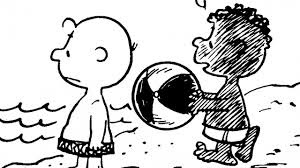
There’s lots of bubbling homosexuality within the “Peanuts” gang. I think it’s widely assumed that Peppermint Patty and Marcie are partnered for life--let there be a wedding. What about Schroeder, the Beethoven-loving, accomplished pianist who has zero tolerance for Lucy? I can understand his reticence to come out. Lucy won’t take it well if Schroeder finally says, “Look, Lou. I’m gay.” Lucy has bullying tendencies and, if any Peanuts character were to be homophobic, it would be her. Not because she’s anti-gay; she’d just turn her rejection outward, an overly broad lashing out.


I’d let Linus be, uh, whatever…maybe bi unless it’s an icky love triangle between him and the Brown sibs, Sally and Charlie. It’s plausible Schroeder could be part of the LGBTQ community as asexual. He could be too into his music to think of anything involving physical intimacy. A perfectly played “Ode to Joy” might be his ultimate satisfaction. I’d be good with Franklin being gay. Frankly, Franklin needs more of a storyline; we need to know more about him so he’s more than the token Black character. I’d also find it interesting to have Pig-Pen come out. We gays are a diverse lot. We need to rebut the notion of gays being persnickety Felix Unger fusspots. Let Pig-Pen be a take-me-as-I-am gay dude. He’s shown a different sense of pride already, referring to his perpetual dirt cloud as “the dust of ancient civilizations.” Ooh! Sexy! More alluring than that greased up mechanic down at Bob’s Automotive. Like Franklin, Pig-Pen needs to be further developed. I’m seeing Franklin and Pig-Pen coupling up. Give these two a spin-off!


I need a character from Berkeley Breathed’s amazing “Bloom County” (the comic strip with Bill the Cat and penguin Opus) to be gay. Before “Calvin & Hobbes,” I considered this strip superior to all others. Michael Binkley is the obvious choice. Poor kid didn’t seem to be the boy his father wanted. Michael gets stuck on the school football team because his dad wants him to become a star linebacker. What Michael really wants is to dance ballet in “Swan Lake” and become a hairdresser. Yes, there are some stereotypes there, but Michael is more nuanced. Perhaps I see myself in Michael, but not in terms of ballet--I can’t even do the dreaded wedding reception YMCA dance--or with a hairdressing career. Like Michael, I had stages in which I was seen as an airhead and a nerd. More than that, I align with him because he has an anxiety closet that torments him at night. Oh, Michael, you need a loving gay man to hold, comfort and understand you. (Same for me? Well, let’s hope Michael has more luck.)


There’s probably a hot Power Ranger or Pokémon character, but these things came after my time. No comment. 


There’s probably a lust-worthy or attractively sensitive bad guy to make gay. The Joker? Elmer Fudd? The potentially misunderstood troll in “Three Billy Goats Gruff”? I had an ex who had addiction issues and other elements of a dark side. He regularly told me it was his wild side that drew me to him. It was a convenient stance, a fanciful form of denialism, to convince himself he didn’t need to change. I liked him in spite of his wild side and, of course, it couldn’t possibly last. If Elmer Fudd is gay, someone else can pine for him. I’m out. Let that strapping Paul Bunyan have him.


You’re welcome, everyone. I’ve just made comics and cartoons a welcome space for LGBTQ characters. Holy pianola! We’re here, we’re queer, we’re everywhere. 


[1] I’ve learned that Robin has a thing for queer (as in odd or weird) “holy” expressions. To be clear, not all gays are into knitting. I foresee a grave injury should I attempt to take up the pastime.