Fifty years ago, when I was a kid, there were no gay role models. No out gay actors, singers or athletes; no gay candidates for president; no gay family members or neighbors. And so I went with Mary Tyler Moore.
On Saturday, September 19, 1970, the world met Mary Richards, hoping to make a go of things in the big city: Minneapolis. As the main character of CBS’s “The Mary Tyler Moore Show,” Richards represented a different kind of woman to American viewers: she was still single at thirty. (Network execs balked when creators James L. Brooks and Allan Burns pitched her character as a divorcee.)
Apart from Phyllis’ daughter, Bess, the sitcom was kid-free and I felt very mature, staring into a window of adulthood. Mary Richards was sweet, smart, stylish and solidly single. She had her share of bad dates and seemed to shrug them off. Not her thing. Certainly not the ultimate thing.
It never dawned on me to look to the guys. I liked news writer Murray Slaughter well enough, always with a quip at the ready. I simultaneously cringed and laughed at vain, dimwitted anchorman Ted Baxter. Through Mary’s eyes, I even learned to see through her boss Lou Grant’s gruffness and consider him a softy.

Still, my eyes were drawn to the women. Long before “The Golden Girls,” “Sex and the City,” and umpteen incarnations of “Real Housewives,” my nascent gay leanings clicked with the strong, quirky female characters surrounding Mary: dowdy, self-deprecating Rhoda Morgenstern; flighty, self-absorbed Phyllis Lindstrom; sly, sexual Sue Ann Nivens; and pie-eyed, wholesome Georgette Franklin. These women were independent by choice or by default. (Technically, Phyllis was married to a never-seen Lars, Rhoda married—and divorced—Joe but that was on another show and, while Georgette eventually married Ted, she had a way of keeping him in check.)
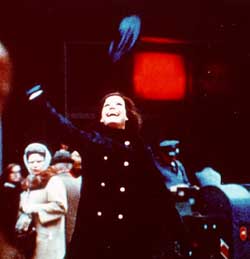
In every scene, I first checked out what Mary was wearing. I marveled at her ribbed turtlenecks. wide-legged pants, diagonally draped belts, plaid skirts and that iconic blue beret she triumphantly tossed in the air as she crossed a busy downtown street in the opening credits. She had a flair and carried herself with confidence. Who wouldn’t want to be like Mary?

Even the wood-block “M” nailed to the wall of her apartment seemed like a savvy accessory. M for Mary, M for Mine. Her place and hers alone.
There weren’t any regular LGBT characters, but I witnessed my first outing of a gay man on the episode, “My Brother’s Keeper,” which originally aired on January 13, 1973. When Phyllis’ brother, Ben, visits, she is intent on matching him up with Mary, but he hits it off with Rhoda instead. Phyllis is despondent—even ruining a party Mary hosts—until Rhoda says, “He’s not my type.” Phyllis, ever volatile, turns incredulous, saying, “He’s witty, he’s attractive, he’s successful, he’s single—”
“He’s gay,” Rhoda blurts, matter-of-factly, to which Phyllis replies, “Oh, Rhoda, I’m so relieved!” Phyllis’ reaction says more about what she thinks of Rhoda than where she stands on homosexuality, but the episode closes with a quiet scene, Mary and Rhoda cleaning up as Phyllis sits beside Ben while he plays the piano. Being gay is tacitly accepted as utterly normal. Groundbreaking for a top ten show in 1973.
When I moved to Los Angeles in my mid-twenties to start a new career and finally come out as gay, I played Mary’s theme song in my head. trying to tune out the tentativeness of the first season version: “How will you make it on your own? This world is awfully big and, girl, this time you’re all alone.” In subsequent seasons, Mary had every reason to feel assured as the lyrics changed to, “Who can turn the world on with her smile? Who can take a nothing day and suddenly make it all seem worthwhile?”
I got really good at smiling. So what if I followed it up by staring at my shoelaces.
I was dating and my luck with men wasn’t any better than Mary’s. If she had her share of bad dates, why wouldn’t I? I struggled to shrug them off like Mary, but then dates didn’t come as easily to me in the first place.

In 1991, I participated in my first protest as marchers decried California Governor Pete Wilson’s veto of legislation that would have prohibited employment discrimination of gays and lesbians. As we chanted along Santa Monica Boulevard, I observed a woman get out of car on a side street. She cheered us on before crouching down to explain the moment to her young child. I beamed and felt further empowered as I realized the woman was Valerie Harper, aka Mary’s BFF, Rhoda. Sometimes the people you idolize are, in fact, good people.
Alas, after five years, L.A. didn’t feel like the place where I’d make it, after all. I packed my car, intent on heading north. Before leaving, my friend Richard popped by to give me a beret. He’d heard me gush about Mary in gay bars as I sipped club soda, trying to stay positive as men looked right through me. In Vancouver, I’d reset. I’d find a busy intersection and throw my cap in the air—a sign of exhilaration, a nod to pending triumph.
But I held off. I wanted to exude Mary’s confidence.
It took a couple of years before I felt ready. Success was sketchy at best, but the symbolic act would be an act of faith. I searched my closet, but the beret was nowhere to be found. I never throw anything away; it would turn up. But it never did.

Five years ago, I readied for my ultimate pilgrimage: a four-day road trip to spend a week in Minneapolis. I dug out a Gap baseball cap from the bottom of a drawer, the letter “G” front and center. G for Gregory, G for Gay (and, yes, for a certain store brand, I suppose).

I fell in love with Minneapolis, particularly its lakes and art museums. I took selfies outside the grand home that served as the exterior shots for Mary’s first apartment. The house had a For Sale sign and, for five minutes, I deluded myself into thinking Mary’s place could be mine...if I happened upon two million dollars.
Based on location shots in the show’s opening and closing, I connected with other Mary spots: Kowalski’s Market where Mary flinches at the price of meat; Basil’s Restaurant where she dines with someone; I even searched for the bridge area where Mary crouches down to feed the ducks. It’s a good thing that my one stint as a stalker involved a fictional person.

On my last day, I headed downtown. Destination: 7th and Nicolett, the intersection where Mary throws her hat. I was excited and nervous. I fretted about asking someone to photograph my moment. I figured I’d work my way into it, first taking some pics of the Mary statue the city had erected on the corner. I stood there and, spun around, wondering how I couldn’t spot the statue. A city official on a Segway sensed my confusion. “Can I help you, sir?”
“I’m looking for Mary. The statue, I mean.”
When he said, “It’s gone,” I almost collapsed. The statue had been removed a week earlier while the area was undergoing a makeover. The worker stayed with me for a few minutes, unsure what to make of my distress. Mary Richards meant nothing to him.
I looked down at the ball cap, tightly crumpled in my hand. I couldn’t conjure up a Mary-worthy smile. Minneapolis was Mary’s town, not mine.
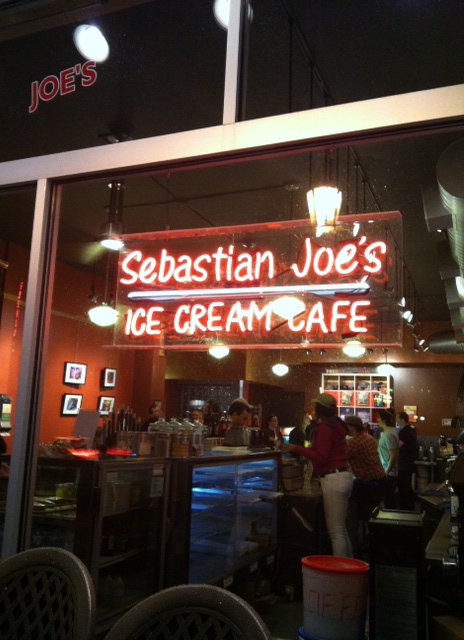
Schlepping back to my Airbnb, I slipped into Sebastian Joe’s for a double-scoop of chocolate mint and raspberry chocolate chip. Mary would have resisted. Sometimes I’m more of a Rhoda.

Listening to “Love Is All Around,” the show’s theme song, still offers an instant pick-me-up. When I’ve got time, I watch an episode. It doesn’t have to be the one about Chuckles the Clown’s funeral or the premiere, featuring Mary’s hilarious interview with Mr. Grant. Any episode will do. The show has transcended beyond the easy laughs from Sue Ann’s barbs and Ted’s news blunders. I’m just thankful to spend more time with my imaginary friends. In the finale, Lou Grant chokes up and says, “I treasure you people.” I couldn't agree more.
I take heart knowing that even Mary stumbled and faced roadblocks. After seven seasons, Mary (along with Lou and Murray...but not Ted) got fired from the WJN newsroom. Although the theme song declared she was “gonna make it after all,” it would just take a little longer.
And here I am, 55 and single, living in a hastily rented apartment after the coronavirus sidelined another bold restart. It’s only a coincidence that the building is on Richards Street, but I take it as auspicious. I’m still waiting for my hat toss moment.