Tuesday, March 22, 2022

A SIMPLE CRUSH


It seems I’ve got a schoolboy crush. It’s simple, based on very little and it’s not going to go anywhere. I’m one hundred percent good with that. I just like the fact that, at fifty-seven, this guy can still have such a thing…and pretend the word “schoolboy” has any application to me.


I’ve attended lots of author talks, gone to many writers’ conferences and bought some books on writing, but I’ve avoided classes. I feared them. I didn’t want my writing to be dismissed or mocked. I didn’t want to be overwhelmed by the vastly superior talent in the room. More than anything, I didn’t want irrefutable confirmation that I couldn’t write. 


At the beginning of 2022, I decided I needed to shake things up. I wanted something more than a one-shot workshop about writing. I enrolled in an eight-session writing class called Queering the Personal Memoir…or something like that. It’s offered by Hugo House, a wonderful writers’ hub in Seattle. I’d attended a few afternoon workshops there in the past, always looking for an excuse for a road trip to the Emerald City. Pre-COVID, these were led by local authors and attended by local writers and Spice Girl song title folks. A sunny side up result of the pandemic is that, by offerings going online, the faculty and the students come from farther afield. Our instructor is a published author who lives in New York City. We’re a small group of students, but we hail from Seattle, Dallas, Orlando and NYC. Two of us are from Vancouver. 


During the first two sessions, I was highly distracted by…myself. I’d participated in many Zoom events but, typically, I was a listener, taking in a performance or an interview with an author. Zoom one-on-ones with a mortgage broker or a psychiatrist were brief. I’d see my image in a rectangle on the screen, but I managed a fair job of fixating on the other person’s tie or the yellow sponge resting on the counter in the background. What kind of person doesn’t put a soggy sponge out of sight? But these writing classes go on for two hours. There are usually nine of us in attendance and I can amuse myself by pretending we’re some queer version of “Hollywood Squares” or the opening title of “The Brady Bunch.” But then I get bogged down remembering that closeted Paul Lynde died of alcoholism and closeted Robert Reed died of AIDS. The distracting images lose their fun factor. I stop visual contortionism and, there I am again, right there in the Jan Brady box, middle child syndrome bubbling up again. 


Focus! They’re talking about writing. Something about a braided essay. Or, no, they’ve moved on to discussing the stakes in the work.


I’m paying for this! It seemed a reasonable amount but then there was that conversion to Canadian dollars. I really need to get something out of this.


 

Still, that face of mine. Disappointing. Frightening. Weary, gaunt, so old. If the Italian mafia, a Mexican cartel or the Norwegian underworld find some need to torture me to confess something, all they’d need to do is sit me in a tiny room and force me to stare at my image. “Okay, okay! That yellow sponge in the background was mine!”


Thankfully, someone told me to put a Post-it over my image. Brilliant! My level of technological problem solving. I have to move the Post-it around as my face appears in different places on screen, I’ve gotten speedy at adjusting. It’s like an office supplies version of Whack-a-mole.


I’m now drawn to another distraction, a more pleasing one: a classmate. My crush. He had me from the moment he logged in that first class. Feast your eyes on that background! The entire wall was filled by a bookcase loaded with books. 


And then, of course, there was the figure sitting in front of all those books. A strikingly handsome Black man with closely cropped hair and a starkly serious demeanor that jolted me every time he broke character to flash a smile. 


This man is not one of those students who needs to speak every five minutes to process his learning or to show what he knows or thinks he knows. There’s one in every class, right? Actually, in this class, there isn’t. These are genuinely nice people, the kind I’d show up to class early for just to hang and get to know each other more. Especially a certain someone. My crush often holds back, sitting silently as others chime in each week. Then, he takes his moment to offer a sage comment about tweaking the structure of an essay in a simple yet shape-shifting way that makes the writer’s work more polished, more powerful. 


Bonus factor: the clothes! Every week he’s appeared in a gloriously stylish cardigan or hooded sweater, something that tells me it’s brr-cold in The Big Apple, something that begs to be touched. Yes, there’s a sunny side down to all this Zoom-i-ness. 


This week the class spent the first hour critiquing my 3,000-word essay. My anxiety and insecurity led me to writing eight possible essays to turn in, each sounding more overwrought and woe-is-me. After slogging through one that was a greatest hits medley of All that I Wrong with Me, I’d had enough. Verbal diarrhea and persistent nausea are not the writerly vibes I strive for. I drafted a new essay, this one “lite” and packed with humor…or, at least, what I think is funny. How would the class react? What if my crush held his starkly serious demeanor for the entire two hours? What if he attacked my work? What if he said nothing at all, eyes downcast as he examined Wordles on the phone resting on his lap?


They thought it was funny! Feedback included references to Andrew Sean Greer and the hallowed Nora Ephron. Okay, not with regard to the whole essay but, if someone can cite an Ephron moment, I’m doing an (extremely clumsy) happy dance. 


Find yourself a Post-it to block that image. 


When my crush chimed in, he smiled. He said, “There were laugh out loud moments on every page.” He cited examples and, by golly, laughed out loud. It wasn’t a throwaway “LOL.” He meant it!


My crush chimed in again later, laughing again, saying he wanted to know more about what I’d referred to as a past partner’s “condom collection.” Well now. This was getting intimate. In truth, there was zero innuendo in his comment, but I prefer to misinterpret as I wish. That’s what crushes are all about. Lots of imagining what could be, even when Be Mine will never be.


Two more sessions to go. We’ll review his essay on the final day. I’ll be unabashedly biased, gushing over his catchy phrasing, his refreshing point of view and how hooked I was from the first paragraph. If it turns out this man can’t write, I’ll sound like a fool. But then that’s how crushes go. I’m such a silly schoolboy. At my age, it feels good.


Monday, March 14, 2022

TRAVELS WITH LIZBETH (Book Review)


By Lars Eighner 


(St. Martin’s Griffin, 1993)


I stumbled on this book title after spotting an obituary last month in The New York Times. The headline caught my eye: “Lars Eighner, 73, Who Wrote About Being Homeless.” (Eighner died on December 23, 2021 in Austin but his publisher, St. Martin’s Press, found out about it more recently.) I have long been consumed by issues of homelessness and frustrated with my inertia in doing something about it. I donate to a local charity that provides meals to people living on the street, I occasionally purchase grocery gift cards and hand them out during times of the year far from the annual “season of giving” and I have often included homeless characters in my manuscripts, including my published middle grade novel, Fouling Out. 


I knew I absolutely had to read this book.


It just so happens that Eighner was a gay man who earned some money as a writer prior to being homeless and while being homeless. His genre: erotic gay fiction. Eighner intones that every story he wrote was accepted for publication. Damn! I don’t have anything like that track record. (I’m not about to enter the erotic gay fiction market. So often, writers are told “write what you know.” Thus, I must disqualify myself and, for that, avid readers of erotic gay fiction can be grateful.)


Eighner was homeless for much of the period from 1988 to 1991. In the 1980s, Eighner was living in Austin, Texas, working in a state mental hospital. He clashed with a supervisor, though the circumstances aren’t detailed. It seems that, in part, Eighner, objected to mistreatment of some of the patients/residents; as well, he felt he could do better working with higher functioning residents. He was given the choice to resign or be fired. By resigning, he didn’t qualify for unemployment benefits. When finding a job proved more challenging than expected, he couldn’t pay the rent for the shack he lived in and, with eviction looming, he took what possessions he could and decided to hitchhike his way to Southern California, thinking job prospects would be better in an area of the country where writers seemed to be in demand.


Lizbeth was his dog, a black and white mutt to whom Lars doesn’t assign Best Dog Ever qualities. She’s just a dog, not especially bright, not especially anything. But she’s his. While housing prospects would have been better without a dog in tow, giving her up was never an option. On colder nights when he’d sleeping among bushes, he and Lizbeth provided one another a trace of warmth. On hotter days in desert areas, much of time was consumed trying to find enough water for the two of them.


Eighner’s homelessness had nothing to do with alcoholism or drug addiction. For some, that would make him a “worthier” character study; for others, that would render the memoir less compelling, being as there was one less struggle to overcome. I hesitate to add that he comes across as highly intelligent—another factor on the “worthy” scale. The New York Times obituary mentions that Eighner studied at Rice University and the University of Texas, ultimately dropping out due to bouts with migraines and “a falling-out with his family over his sexual orientation,” a circumstance common to queer youth, sending them into adulthood at a disadvantage.


The hitchhiking parts of the memoir feel monotonous, probably because that’s how it was. Eighner was at the mercy of whoever stopped and, often, the drivers were dubious characters with very little money themselves, recklessly driving cars that would break down. Another writer might have played up the drama, but Eighner delivers his accounts flatly.[1] When he made a second roundtrip hitchhiking journey from Austin to L.A., I thought, Please, no…less for his sake than mine. 


Still, his accounts of being homeless don’t need to be emotionally heightened. There’s a relentlessness to the life. Some people offered simple kindnesses while others—particularly, it seems, the residents of Tucson—preferred to kick a guy when he was already down. There’s a section on dumpster diving, published as a stand-alone piece prior to the book, that gives a flavor of how to be resourceful and self-sufficient. Eighner kept to himself instead of joining other homeless people at makeshift encampments. As well, he didn’t access supports such as meal programs and group shelters, in part because he had Lizbeth with him. He also resolved to never beg for money. 


Eighner explains there’s an art to knowing where the best dumpsters are and learning the times of year when they yield greater finds. His account speaks to how wasteful society is, even as that’s to his benefit. Eighner also offers insights into how to make the best guesses as to what food finds are less risky to eat than others although he mentions having dysentery about once a month since there are always risks. This comment, more than anything, has added to my empathy for homeless people I see in Vancouver. Many times, I come across people who have soiled themselves and, on one occasion, I searched to find a thrift shop to get the passed-out individual a towel and another pair of pants, wanting to spare the fellow the indignities that would greet him upon his awakening. Alas, there’s nothing available at seven o’clock on a Sunday morning.   


On homelessness, Eighner provides a flavor of daily life, much of it about scrounging for food and water, hiding his few belongings and hoping they’re neither stolen nor vandalized and trying to be unseen so as not to be forced to pack up and find a new place to shelter.


A homeless life has no storyline. It is a pointless circular rambling about the stage that can be brought to happy conclusion only by a deus ex machina. 


Rent, deposits, transportation, suitable clothing, living expenses: the kind of money required to obtain a home cannot be saved from pennies picked up on the street…[A homeless person’s] fate is no longer in his hands. He may survive, but no more than survive. 


Eighner’s writing is strongest when he makes observations of the systems set up ostensibly to offer help. It’s hardly surprising that Eighner does not speak highly of medical staff and social workers who purport to offer assistance, the offerings piecemeal and paternalistic. Of one account, he writes:


The social worker prolonged the interview after it was clear he could not offer me any material benefit. He wanted me to apply for a program that would allow the costs of…his services in advising me that he had no services to offer…This is of course all that social workers exist for: to keep the funds flowing to the institution, thus to preserve their own salaries. Otherwise they are just about as helpful as the average high school guidance counselor.


There’s an eye-opening section from Eighner’s time in Austin where he meets Daniel, a young man with AIDS who has been displaced and who is purportedly on a waiting list for a hospice in Houston:  


I asked Daniel what the local AIDS agency had done for him. He said they were mostly burned-out on him. Although I had donated what I could to the AIDS agency, I did not have much confidence in them. I could see, however, that Daniel was a hard case, a prickly pear.


Most agencies, and especially their volunteers who do so much of the real work, want cuddly, warm clients. In the case of AIDS, that means the volunteers are best prepared for people who will lie down and die quietly. Many people…envision themselves as ministering martyrs among the lepers. They imagine the work will involve many tender and touching moments as their patients struggle to express eternal gratitude before expiring gently. Such scenes are filmed through gauze and Vaseline.


It should be obvious that this memoir by a gay man has little to do with being gay. Eighner’s account is of a homeless man who happens to be gay. It’s more a tale of a man and his dog than a man seeking another man. (Lizbeth died in 1998 at the age of thirteen, still with Eighner.) There are a few brief references to sexual encounters. (Is it terrible that I felt jealous of a homeless man having better “luck” than me? I know…shame.) What may prove surprising, even fascinating, is that Clint,[2] a character Eighner and Lizbeth knew from their days in the shack in Austin, pops up again much later, joining Eighner in being homeless. We learn in the afterword that Clint and Lars, characterized as the beauty and the beast by the writer, remained a couple, the relationship continuing for twenty-three years as of 2012. Eighner’s obituary notes that the couple married in 2015 and remained together—thirty-three years—until Eighner’s death. Love may not overcome everything but what a testament to silver linings.  


[1] In the Afterword, written in 2013, Eighner alludes to Asperger’s, noting, “Many have noticed my dispassionate tone throughout the book…Lately it occurred to me that there might be an underlying cause…I acknowledge I am indebted to Jim Parsons for his portrayal of Sheldon Cooper; I now understand so much better what has always been wrong with me.” A shame that he would word it that way.


[2] All people mentioned in the book are given fictitious names. I love Eighner’s extraordinarily logical explanation: “I have changed the names of people and of institutions…I know my perspective did not often reveal the best side of people. When it did, I think I best return the favor by respecting the privacy of those who helped me. At any rate, I thought to name some and not name others would imply a criticism that, in some cases, I did not intend.”


“Clint” remains so in the afterword while other people are named. “He did not sign on to be a public person and so remains ‘Clint.’ The obituary discloses that his name is Cliff Hexamer and that Eighner took Hexamer’s last name when they wed. 


Tuesday, March 8, 2022

MAKE ME LAUGH


Funny guy.


Makes a damn good first impression. I’d forgotten that. Heck, thanks to COVID, I’d forgotten any kind of first impressions. 


I’d spotted Evan’s profile on a dating site—no, not this one—in December after expanding my search range since there was a paucity[1] of men from Vancouver with profiles. Evan lives in Seattle. Doable. The city, I mean.


So often guys fail to elicit any interest in their profiles due to a lack of photos. Posting a single shot is suspect. Like maybe he had one good day in 2008 and the photo turned out to be spectacular. It doesn’t even look like me! (Not even back in 2008.) Other times, a guy will post a photo of a mountain or a pyramid. (Vegas? Giza? In this case, does it matter? I don’t fantasize about dating a mummy.) Sometimes, the guy is actually in the shot. Tiny. Size of an ant. It was really important to get the whole mountain in frame. I could go on and on about guys’ profile pics. Bottom line: do better, dudes.


Evan was not photo-challenged. Nine pics, himself the main subject of each one. 


Evan’s photo gallery showed personality. A true character. Evan in cowboy gear. Evan in leather (not kinky, but another version of a western look). Evan on a hike. Evan on an Alaskan glacier. Evan flashing an impish grin. Evan at the beach, shirtless. (It’s the beach after all and, yes, it’s a nice look.) Every shot was arty. The man knew how to present himself. I’m not one for leather—my standard line is, “I’m a vegetarian”—and I fled Texas after eleven years, needing distance from All Things Cowboy, but to each his own. What struck me was this guy oozed style and after so many dates with guys showing up in a Batman t-shirt or sweaty gear after coming from the gym, style warranted a message.


The next day I had eleven messages from Evan. Okay, I realize that can sound creepy, but it wasn’t. Evan, like my friend Katrina, is one of those people who presses Send after every separate thought. In this context, Evan’s flurry of messages was a stand-out. A man willing to express eleven thoughts at the outset. This goes so far beyond the standard “Hey man” or “Thanx 4 the msg how r u”.


We exchanged messages off and on over the next three and a half months and, as COVID numbers started to go down again, I decided a road trip was in order. Meeting Evan was a catalyst, but I’d been missing the Oregon Coast as well as craving more time in my old haunts in Seattle and Portland so all the better. After booking places to stay, I let Evan know of my upcoming two days in Seattle.


He’d be in New York for work.


Work sucks.


What happened to all that working from home business?


Still, since this trip had very little nothing to do with Evan, I opted not to postpone plans by a week and had a truly amazing time. I’m someone who needs to travel. 


All was not lost on the Evan front. I would have to drive through Seattle again as I returned from Portland. We agreed to meet for a drink. Perhaps it was inauspicious that I showed up a couple of minutes early and the bar was closed for a private event…someone’s memorial. That felt like the gods were making a point of going beyond spilled salt, broken mirrors and walks under ladders. I might have to chug my drink and flee, saying something about long border waits as I pushed the toddler standing between me and the exit.


Evan showed up, wearing denim and a stressed caramel leather jacket, flashing his grin and within thirty seconds I was laughing. It wasn’t even a block to the change-of-plans margarita destination—chugging and fleeing would not be very responsible—but I filled most of that space of time continuing to laugh. It was an easy back and forth. I’d like to think my banter was as breezy and amusing as his. 


In arranging where to meet, I’d suggested coffee, but Evan had indicated he’d need a drink because he’d be nervous. I’d texted back, duly lowering his expectations, saying I don’t make people nervous. It’s not even possible. True, but perhaps a self-sabotage in the realm of self-promotion. All my in-person giddiness led Evan to comment that I was the nervous one. Nope. When I get the giggles, they stick around. Rather than nervous, I was instantly at ease with Evan. (He still thinks I was nervous.) 


It’s entirely possible that Evan could say something mundane like “Today I saw a bird with wings,” then punctuate it with a grin and I’d crack up. I have no idea if others find Evan funny, but he’s hysterical to me. Let me be his laugh track.


The quick drink lasted five and a half hours. Yes, lots of laughs, but also plenty of serious conversation as well. We clicked. 


I don’t know what, if anything, will come of us. Last week I officially abandoned my ten-year quest to move back to the United States. Seattle’s a three-hour drive on a good day, five on the not-so-good (and more typical) days—a tunnel, a border wait and ridiculous Seattle traffic lie between us. I saw a couple of red flags regarding Evan. Then again, I don’t think there is a single gay man in his fifties who doesn’t have a few fiery banners flapping in the wind behind him. I openly shared several of mine as well. Not something I’d do on a first date with a local boy but, with the distance between us, why not put everything on the table? If I’m too much, I’ll at least save myself a couple of trips. Gas ain’t cheap these days.


It’s two days later and the feeling of joy remains. We’re still texting so the red flags aren’t death knells (yet).


Funny guy. 


Maybe we have wings, too.


[1] Ooh, I’d forgotten how much I love this word. Haven’t used it in ages but it just popped up. Welcome back.

Friday, March 4, 2022

QUILTING B...AND THE L, G, T, Q, TOO


Sometimes—fairly often, in fact, and increasingly so—I feel I’ve been living under a rock.[1] I still don’t have a TikTok account and I don’t really get its purpose as a platform. From what I gather, it has something to do with really short videos and, as these posts exemplify, brevity isn’t my thing. I also haven’t hopped on the Wordle bandwagon. Haven’t played it, if “playing” is even the right verb, haven’t Googled it, haven’t had a single chat about it. Honestly, I don’t want to Wordle…again, if that’s the right verb. (If it’s not, surely it will become a verb.) 


This morning, while searching the internet for the umpteenth time to find a potential agent who will LOVE my manuscript, LOVE me, take me as a client and land me a six-figure publishing deal (seven would be okay, too), I came across a term I hadn’t seen before. The agent’s blurb said she was seeking works by traditionally underrepresented authors, including “POC, LGBTQ+/QUILTBAG, neurodiverse, body diverse, and disabled creators.” Lots packed into that statement, lots that makes me excited about publishing striving to be more inclusive. I see many agents make similar (though less comprehensive) statements, whether they’re made genuinely or just because that’s what agents are supposed to do now. The cynic within me wonders how many diverse authors they have and, if none, then will they be content once they get one? Whew! Tokenism at last!


Quite frankly, I’m at the point where I’ll be somebody’s token, even if the “gay” token isn’t as shiny and new as other categories under the diversity umbrella.


Which brings me back to my Term of the Day: QUILTBAG. 


Huh?


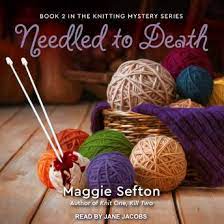
My first image was of a writer walking to a café with a laptop under one arm and a handsewn, oversized purse hauled about in the opposite hand, knitting needles and colorful balls of yarn poking out. I hadn’t realized crafty folk were underrepresented in the literary world. A quick Google revealed there is a potential sub-genre under crime fiction for “knitting needle murders.” It’s a thing. In just ninety seconds online, I came across these books titles: Death by Knitting; Murder, She Knit; Murder Tightly Knit; Needled to Death. 


Note that the cover indicates
this is the second book in
a knitting mystery series.
Horrors!

I would like to suggest to this agent that crafty, “quilty” authors may not be underrepresented. In fact, I’m hoping the crafty, “quilty” publishing trend is on the wane. I’m developing a fear of quilters. Out of an abundance of caution, I’m never visiting Great Aunt Leonora again. I’ll miss her plate of digestive biscuits, but I’m big on safety first. Besides, I don’t need another handmade tea cozy.


It turns out that’s not what QUILTBAG means. Sometimes I forget that all-caps doesn’t just mean people are shouting or trying to tweet like Trump. (For the record, both these undertakings REALLY OFFEND me.) 


QUILTBAG is another queer acronym which stands for Queer/Questioning Undecided Intersex Lesbian Transgender/Transsexual Bisexual Asexual Gay/Genderqueer. We can thank someone named Sadie Lee for this term. 


Any acronym that purports to represent a broad range of gender and sexual identities will fall short, particularly when these identities continue to evolve now that societies and queer communities are becoming more accepting of a fluidity of sexual orientations and classifications beyond a gender binary. The omission that stands out most for me is Two-Spirit identity. True, Two-Spirit also isn’t expressly noted in LGBT or LGBTQ, but those acronyms use the G and the Q respectively to represent a catchall for a broader community. As acronyms get longer to expressly represent more people, the perceived omissions come off more as slights which offend. What about me? QUILTBAG2 anyone?


I suppose I could get behind QUILTBAG if it took off. To be sure, it rolls off the tongue easier than LGBT or LGBTQ or—deep breath—LGBTQIA2S+. I appreciate that. News anchors, reporters, well-intentioned queer allies and the like must surely hope QUILTBAG sticks. 


But it hasn’t. It doesn’t even make an appearance under the “Variants” subheading of Wikipedia’s LGBT entry despite the fact a quick Google shows the acronym going back to 2012 at least. Maybe I’m not the only queer who has concerns about knitting needle nightmares. Maybe there are butch femmes and leather daddies who see the quilting image as something stereotypically feminine. Maybe we’re all just labeled out. I appreciate that, too.


[1] Such an odd expression, isn’t it? Being as I’m SIGNIFICANTLY larger than a potato bug or an earthworm, how is that even possible? Plus, I don’t think I could tolerate the dank, musty environment.

Tuesday, February 22, 2022

BONJOUR, MONTRÉAL!


Well, here’s a surprise [Quelle surprise!]:


I’m moving to Québec. 


It seems I must. If I want to find love, or at least go out for a coffee with a guy who decides my profile pic is decent enough for him to be seen in public with—the bar keeps getting lower—I must pack my things and find an apartment in Beloeil or Vaudreuil-Dorion or Prévost. These are the places where the guys are. 


Guys who (presumably) aren’t married.


Guys who are my age-ish.


Guys whom Silver Singles has decided are my matches. One-third of my sixty-three matches thus far live in La Belle Province. Only eleven live within a two-hour drive of me. (To clarify, I live 4,550 kilometres from Montréal and 4,800 kilometres from Québec City.) 


Au revoir, Vancouver.


I don’t speak French. It may be reputed to be the language of love, but I have a hunch it’s a barrier when one is not doing love-y things. How many times am I allowed to say, “Ooh la la,” before a guy shows me la sortie? 


I realize that most French-speaking residents of Québec can also communicate fluently in English, but there’s a measure of respect that comes with speaking the language that is the mother tongue for a majority of citizens in the particular province where you live. Plus, I want to be able to eavesdrop on what my guy is saying about me on the phone or across the table to his friends and Maman. 


The sad thing is that I’ve spent many years purportedly learning French. My level plateaued in ninth grade. (This comes after only beginning French studies in sixth grade.) My family moved to Texas during the summer before I started grade ten where most students learned Spanish as their foreign language. My level of French was “advanced” by East Texas standards. This was not high praise in a place where English sometimes seemed to be a foreign language. My father required us to act as interpreters whenever a server took our order at a restaurant. (He’s since adapted to the drawl, even adopted some of it.) My classmates thought my Canadian “accent” was British. Needless to say, I was never going to read Victor Hugo’s Les Misérables in its original language. (At 1,462 pages, it’s doubtful I’ll read the English translation either.)


I’ve been learning French on Duolingo. I’m on a 930-day streak. That’s something, right? 


Apparently not much. I recently decided I need to take an intensive French course, something more immersive than twenty-item exercises from a green owl (une chouette verte). I took an online test through Vancouver’s Alliance Française and then attempted to engage in a brief conversation on Zoom with an instructor. My French level was assessed as B1 which basically means I can use my skills to order poutine, complain about the weather and identify the colors on the Pride flag. It also means that if someone actually attempts to engage me in a real conversation in French, I’ll put my head down and cry. 


Maybe Frenchmen in Québec find communication issues and crying attractive. Maybe my go-to “ooh la la” will never cease to be amusing and sexy in a Je ne sais quoi kind of way.


Pierre: Regardez. Un bus.

Moi:    Ooh la la!

Pierre: Aimez-vous les beignets?

Moi:    Ooh la la!

Pierre: Voulez-vous coucher avec moi ce soir?

Moi:    Ooh la la!


Maybe I should have moved to Montréal long ago!


Ah, but then again, maybe not. Maybe Silver Singles will just have to do better in the matchmaking biz.    


Tuesday, February 15, 2022

JUST FOR ME


The West End in Vancouver was my first time living in a gay ghetto. Nobody else referred to it as such but I suppose I felt constrained in terms of choices. The gays seemed to be everywhere and, in other parts of the city, it felt like your chances were better for spotting a leprechaun than someone who even knew what the rainbow flag was. (This was last century, back in 1994.) I thought of the West End as possibly the prettiest ghetto in the world, yet it was a ghetto nonetheless since that’s where we were corralled and contained.


My friends thought this was amazing. Gay men everywhere. A place to feel free. A place to feel a sense of belonging. And then there was all that eye candy, too. 


When I’d lived in L.A., the gay ghetto was West Hollywood. It felt more ghettoized in the derogatory sense. It was hard to access since it was a considerable distance from the freeways—so many stoplights—and I thought it was plain ugly. Drab. The section of Santa Monica Boulevard traversing the community was lined with ho-hum businesses with zero curb appeal and even less shopping allure. It may have been adjacent to Beverly Hills, trendy Melrose and tourist-packed Hollywood, but it looked and felt like nowhere-land, a place the gays could have by default. I know many gay men will strongly disagree with me, likely due to having so many memorable experiences in the nightclubs there. I had fun times there as well; it just didn’t look so great in the daylight. Plus, there was a lot of attitude in West Hollywood. It could feel like a place of dismissal rather than a place of belonging. L.A. was a town of model/actor wannabes who paid the rent from catering gigs. The gays flocked there because people back in Omaha and St. Paul told them they looked like a movie star. They practiced that inaccessible persona before ever landing a hemorrhoid commercial that would surely be their big break. West Hollywood was a nice place to visit (in small doses), but I never wanted to live there.


My apartment in Vancouver’s West End was three blocks from the beach. Other than work, everything was in walking distance. I’d meet friends twice a day for coffee at Delany’s down the block and we’d grab window seats to view the daily gay parade strolling along the sidewalk. Sometimes we’d take our coffees down to the beach to sit on a log to watch the sunset (and maybe a few more strolling gays). For the first few months, I loved it. Everything was overwhelming in a good way, like when a kid is at Disneyland or every time I step into Vancouver’s La Casa Gelato and have to choose from 238 flavors. (I can quickly eliminate Roasted Garlic and Chocolate Bacon, but does that even count as narrowing things down?) 


It wasn’t long, however, until I felt I was living in a pressure cooker. I have social anxiety (at the time, undiagnosed) and low self-esteem (at the time, blatantly obvious) so I worried every time I left the apartment. Back then, I’d put myself out there. Despite my insecurities, I had outgoing friends I could hang in the shadow of. I believed in love and I felt certain the ghetto would yield great prospects. Once I fell in love, I wouldn’t have to live in the ghetto anymore. That made for high stakes every time I stepped out. There was a 100% chance I’d see someone who was gay and I had a 90% shot of seeing someone I knew…a friend from the gym or the coffee place or a friend of a friend whom I’d been introduced to and knew by name even if they didn’t always know mine or recall ever having met me.  


I had to look presentable—datable—every time I was in public. I couldn’t just dash to the grocery store a block away to get milk. I’d heard about people having flirty conversations while searching for fennel or selecting a desirable banana. Maybe my future partner and I would reach for the same carton of skim milk at the same time, leading to love and a commitment ceremony six months down the line. (Things move fast when it’s love at first sight. If we liked the same milk, surely we could build on that.)


The ironing board in my bedroom rarely got put away because I ironed all of my casual clothes. If I stepped out in a wrinkled shirt, I was certain men would be turned off. I even ironed my gym shorts. If I steamed and spray starched just right, men would notice me. I’d get a boyfriend. We could drink skim milk together. 


I wasted so much time ironing.


Nowadays, that same ironing board is somewhere at the back of my closet in the booby trap zone. Pull one thing out and ten other objects come crashing down. That’s my excuse for not ironing. I wear wrinkles now—on clothes and, sigh, other places. I’ll blame COVID as the reason I’ve stopped putting any effort into what I look like. As my hair grew and grew during lockdown, I’d glance in the mirror before heading out and realize no amount of sculpting putty or gel could tame the wild mane. I was thankful I could partially hide behind a mask—which also got me out of the habit of shaving. Lockdown let me let go. Freeing? Yes. But it was supposed to be temporary…the virus and the shaggy, unkempt look.


Temporary still doesn’t have an end date. 


When I go to the grocery store, I make sure my shoes match, but that’s about it. Finding my match over a carton of skim milk sounds ridiculous. I’ve moved on to oat milk, after all. Winter isn’t particularly cold in Vancouver, but I still put on a coat whenever I head out. No one is going to see the shirt I’m wearing and how well it fits or doesn’t. No one will notice if my socks complement anything. I have a limited mask collection from which I try to select the best match, but I don’t want my face apparel to get me noticed. (Face apparel…did you ever think?) I don’t want to get involved with some guy who has a mask fetish. 


I’m still overly cautious about the coronavirus, Delta variants, Omicron and whatever’s next. I know there are people with the view that they should just get it and get it over with. I’m of the opposite view. I’ve spent two years being super careful. Why would I give in now? What would all that vigilance have been for? To each his own. Practically speaking, my caution means I’m not writing in cafés for the time being and I’m not meeting friends at indoor spots. We’ve had lots of great walks. I don’t feel deprived. I could have a tantrum and announce, “I’m done with COVID!” but, at the moment, that’s as potent as declaring, “I’m so over taxes” or “Donald Trump does not exist.” Fanciful notions but nothing more.


What all this comes down to, for the purposes of this post at least, is how I feel about being a fashion dropout, content with wearing a sweatshirt with an armpit hole, gym shorts with frayed hems, running shoes with the soles worn down and a jacket with thread dangling where a button is supposed to be. (I’m sure there’s a YouTube video on how to thread a needle, but I’m self-aware enough to know I’d need a medic on hand if I tried to follow along. I have to accept the fact that healthcare workers have more pressing matters, pandemic or not. This is also why I won’t try one of those electric scooters. Or hopscotch.)


It’s freeing to know how I look and what I wear doesn’t matter. I can save energy by getting dressed in the dark. I could do away with shampoo. Why do I need to take a shower when it rains here regularly? I can just leave the umbrella at home and multitask when it’s pouring, getting a cleanse as I pop out for more oat milk. It doesn’t matter!


Ah, but it does. Or maybe I’d like it to. Just a little. I have bought a few nice casual clothing items in the past year and, for a while, they were left hanging in my closet, tags still on them. There hadn’t been an occasion for wearing them. Why would I dress nicely just for me?


I’m beginning to try again. I don’t know if I feel any better about myself from wearing something that isn’t tattered or that only has the holes that originally came with it. I’ve watched enough episodes of “Queer Eye” to know I’m supposed to feel better. 


Honey, I’m gorgeous! 

I’m owning this look! 

I can rock a French tuck! 


It probably works better when a crew arrives and totally redoes my condo as a little side project. 


Maybe my fancier days during this pandemic are dress(up) rehearsals. Maybe I’ll leave the mask at home someday. Maybe a cashier or a barista will pause for a split second and say, “Nice shirt, sir.” Or maybe I’ll just whisper that to myself, minus that unsettling respect-your-elders “sir” tag.


It’s been twenty years since I lived in the West End. After doing a circuit of living in other parts of the city (and beyond), I’m West End-adjacent. It doesn’t feel like a gay ghetto anymore. It’s rare that I step out and run into someone I know. Gaydar is rarely even activated. People see me as much as I see them, which is more about social distancing logistics than anything else. Post-pandemic, it will remain so, at least from my perspective since the social anxiety is vaccine-averse.  


Shaving, showering, dressing with the light on…it’s all for me. Practically speaking, I suppose it always was.