Showing posts with label AIDS. Show all posts

Monday, March 2, 2026

WHERE THE BOYS WERE


Sad to hear that Neil Sedaka died last week. Eighty-six may be a ripe, old age but it happens to be my mother’s age so it once again gives me pause to wonder how long her good health will hold out. Fingers crossed.


I’ve been known to go down a Neil Sedaka rabbit hole a couple times a year. YouTube does me the courtesy of selecting “Laughter in the Rain” whenever it finds itself on a ’70s loop which seems custom-made for me.


When Sedaka’s death was announced, I did some Googling about his life and his music. Didn’t know he gets a shout-out—“Sedaka is back”—at the end of Captain & Tennille’s “Love Will Keep Us Together,” a song he co-wrote with his frequent writing partner, Howard Greenfield. That, of course, sent me down another rabbit hole: Who was Howard Greenfield?


The first thing that struck me was Greenfield lived a much shorter life, dying just shy of his fiftieth birthday in 1986. What had happened to him?


First, however, being the pop music geek I am, I read about the hits he wrote with Sedaka, including ones Sedaka recorded such as “Breaking Up Is Hard to Do,” “Calendar Girl” and “Oh! Carol” (in honour of Carole King) and those the pair wrote for others, including “Where the Boys Are” by Connie Francis and Captain & Tennille’s “You Never Done It Like That.” With other collaborators, Greenfield wrote “Crying in the Rain” by the Everly Brothers, “Venus in Blue Jeans” by Jimmy Clanton, “Foolish Little Girl” by the Shirelles and “Two Less Lonely People in the World” by Air Supply. He also co-wrote the theme music for TV’s Bewitched. (Try to get that out of your head now.) Greenfield was posthumously inducted into the Songwriters Hall of Fame in 1991.


So what happened to Greenfield? Why did he die so young? According to Wikipedia, Greenfield was openly gay and partnered with cabaret singer Tory Damon who also died in 1986. 


Still, I did not put the pieces together.


Greenfield died of AIDS complications on March 4, 1986 and Damon died from AIDS three weeks later.


I bonked my forehead like they do in those “I could’ve had a V8” TV commercials. 1986. AIDS. Of course. 


Just last week, a friend and I were talking about how it almost seemed COVID and the worldwide lockdown from six years ago never happened. How quickly we get back to “regular” lives. How quickly we forget.


I swore I’d never forget the AIDS crisis which I lived through during my years coming out. This, however, feels like a lapse in memory. Only a decade ago, I would have first assumed a male dying young in the mid-’80s died from AIDS complications. Has AIDS fallen off the radar…my radar? This serves as a reminder that it is important to keep real and creative stories about AIDS alive.


Too depressing
, I’ve heard too many people say. “I want happy gay stories,”a friend of mine has said many times. I’ve seen agents requesting works of queer joy. All good. Still, AIDS happened. We must not forget. Movies like Longtime Companion and Philadelphia were important at the time, humanizing AIDS when fear and hate were often associated with the virus. They now feel like historical blips.


It feels we’ve failed to keep narratives about AIDS alive. Contrast this to the Holocaust which always remains ripe for a book or film. If not stories of persons dying of AIDS, where are the works about people who survived this brutal period where, in North America and Europe, at least, it was treated as a gay disease, another reason to shun and actively discriminate against gays. 


Yes, there has been great progress this century regarding gay rights but there is much to learn and remember from the AIDS era. Both the hate and the responsive activism can provide insights for the trans community and other queer people. I feel there is a complacency among non-trans queers. Having crosswalks painted over and Netflix not renewing Boots for a second season are not enough to create a rallying cry.


Being belatedly introduced to the career of Howard Greenfield, I am reminded of all the creative men—and the ordinary men—we lost to AIDS. A generation of gay men, my age and older, was culled thirty to forty-five years ago. As far as I know, Neil Sedaka lived a full life; Howard Greenfield, by contrast, had so much more living to do. Greenfield at least leaves a legacy of catchy, upbeat pop songs worthy of remembrance.


Friday, March 29, 2024

OH, FARRELL (Part 2 - A Chance for a Friendship to Deepen)


This is Part 2 of my memories about a gentle man, Farrell Cain, with whom I became good friends while I was still hiding in the closet as a gay man in Texas. (I encourage you to read Part 1 first. I split them up because, as a single piece, it runs a tad long.) 

Farrell had his own closet. Both of us had grown up with the church as an influence and, in '80s Texas, the closet felt safe, if a little smothering. It took me moving to California for us to finally come out to one another, not via conversation--somehow too risky--but by an exchange of letters. Whew! Not we could grow together, a lifetime ahead of us to build on our friendship.


When you have a friendship you know will last, there is always time. Another conversation, another visit. The gaps don’t matter. You pick up right where you left off. Farrell and I had that foundation. After law school, I moved to Vancouver. We continued to keep in touch, mostly by mail.


In March 1996, I called on his birthday. A woman with a thick drawl answered. Sorry, no Farrell. She’d had the number a few months. I figured Farrell had moved. Back then, most people didn’t have cell phones, Farrell (and me) included, and phone numbers didn’t transfer to a new home. I knew he’d lost his job which hadn’t made sense since he was smart, loyal and conscientious…a model employee. Maybe he found a roommate or got a cheaper apartment. He’d mentioned keeping busy by volunteering at the Dallas AIDS Resource Center to do their bookkeeping.  


Three days after his birthday, I sent him a card knowing the post office would forward it. I ended my note with:

Write me a quick note when you receive this so I know how to contact you.

Take care & please keep in touch.


Two months later, as I checked my mail after a gym workout, on my way to join my new Vancouver friends for coffee, the card sat in my post office box, stamped twice in red: RETURNED TO SENDER. My heart sank. Reconnecting with Farrell would require more effort. Calling directory assistance would hopefully do the trick.


But then, as I sat with my coffee, waiting for friends to get their lattes, I looked again at the envelope. I gripped the edge of the table. I felt the breath knocked out of me. Above where I’d written Farrell’s address in blue ink was a note in a lighter blue ink on one of five red lines from the return to sender stamp: “deceased.” I needed a friend to confirm I was reading things right.


It still stuns me when I look at the notation. How often did mail processors write this? Did they think anything of it? Did they wonder even for a second how the “sender”—that’s all I was as far as they were concerned—would react upon receiving it? Did they assume the addressee was someone far older than thirty-seven? They were just doing their job, working through stacks of mail.


In the spring of ’96, it was common to grab coffee with my gym friends and have AIDS come up in conversation. Several friends and acquaintances from Denman Fitness were HIV+ or had AIDS. Some appeared visibly frailer by the week. Some died. Our regular coffee spot in Vancouver’s West End was THE place for gays to congregate. We jockeyed for outside seating or stools by the window so we could cast our eyes on the men filing in and out or strolling by on the sidewalk. Not a coffee passed without the vestiges of AIDS in view—KS lesions; gaunt eyes; rough, discolored skin; canes for assistance; wheelchairs pushed by a friend or lover. My shock over Farrell’s death didn’t land with my friends. There was a certain numbness by then. So much death required some degree of emotional distancing to carry on, to not succumb to anger and despair.    


I can only deduct that Farrell died of AIDS. It was, after all, going around. It’s what gay thirty-somethings died of. It’s likely the reason he lost his job in conservative, God-fearing Dallas. (Did he lose it or was he too unwell?) It’s why he connected with the AIDS Resource Center. His cards mentioned being restless, wishing he could find a job and feeling financial strain. It shatters me every time I think about what he kept from me. Did he think I was too busy? He'd known I’d volunteered at AIDS Project Los Angeles. Why the barrier? Had self-hate and shame kicked back in?


I don’t know how he died, whether it was at home, in hospice or in hospital. I don’t know if he was alone or had a friend, maybe more, by his side, checking in on him, holding his hand at the end, gently telling him it was okay to let go. 


I have quietly lived with mourning and missing Farrell. As with many of my friends, we always socialized one to one. That’s common among introverts which we both were. The conversations are better, the attention undivided. There was no one to call for answers or to mutually console. 


For years now, I’ve wanted to make a panel to honor and remember him as part of the AIDS Quilt. I’ve researched it, I’ve planned what to put on it: symbols for tennis, the symphony, accounting, the University of Dallas and New Orleans Mardi Gras. I went to a quilting store on Granville Island to get a particular hardy tarp-like fabric for the panel, but they didn’t carry it. That one stumbling block was enough to let a simmering doubt boil over. I have a large button I can’t sew back on my jacket. I have jean pockets with unseen holes that need to be stitched. These tasks are not in my wheelhouse. I’m challenged with even threading a needle. How would I ever create a quilt that looked better crafted than a third-grade friendship bracelet? Anything I stitched together would dishonor rather than honor. Noble idea, but nothing I could execute. Alas, my plans remain pinned by a magnet to the filing cabinet in my office. Seeing his name makes me smile. I honor him, just more privately. Maybe that’s all he’d have wanted.


Every so often, I’d Google “Farrell Cahn” again, as if the greater passage of time would turn up some pre-Internet treasure. Sometimes I’d narrow the search, counterintuitively adding “Louisiana” or “Dallas” or “University of Dallas.” I had to do it. I had to feel like I was doing what I could to confirm the life of someone whose memory I seemed wholly responsible for holding. Maybe an obituary would provide closure. So that’s when he died. Maybe it would mention donating to an AIDS hospice. Maybe friends, family or even a longtime companion would be included. Would I reach out to his estranged sister a quarter of a century later? 


After each fruitless Google, I was left with one frustrating conclusion: ordinary people whose entire lives were BGE (Before Google Era) disappear without a trace. 


The only Farrell Cahn to be found on the worldwide web was a physician’s assistant in Burbank, California with a different first name but for whom Farrell was the middle name. But then a Facebook page came up for the University of Dallas. 


My Farrell! Apparently, the one and only Farrell Cahn. 


It took a fraction of a second to glimpse the picture, for it to register that it was a really bad photo and then to realize how precious it was. I burst into tears, an uncontrollable wail, something guttural surging from emotions I hadn’t fully processed over a quarter century. I was inconsolable, overwhelmed by grief, pain, sadness mixed with joy and relief. I found you, Farrell. I found something that goes beyond my personal memories of you. Twenty-first century, this is Farrell Cahn, an extraordinary ordinary man. Look at him bent over, looking up at an unseen photographer as he puts something in a trash bag.  


The Facebook post was from April 29, 2021: 

#fromthearchives Earth Day was last week. Did you help make our campus more beautiful? Farrell Cahn (BA ’80) definitely helped clean up campus in this picture from 1979. Follow in his footsteps and help make our campus a better place.


Farrell the activist? Farrell the environmentalist? Farrell the good guy. That’s something. That’s everything.


Monday, August 16, 2021

A CLEAR DIFFERENCE BETWEEN COVID & THE AIDS CRISIS


Over the last week, eighty-four-year-old gay actor George Takei, best known as Sulu from “Star Trek,” was trending on Twitter. That’s not so unusual. The social media platform has given him a higher profile with more than three million followers, many of whom presumably were not around in the days of Sulu and may have never connected with any of the “Star Trek” incarnations. (Takei also has ten million Facebook followers.) He’s known for tweeting sharp, sometimes humorous, takes on politics, clearly leaning left, as well as regularly recognizing LGBTQ accomplishments. 


In 2019, after Donald Trump refused to denounce the Proud Boys during a presidential debate, Takei took to Twitter, proposing that the LGBTQ community take over #ProudBoys by using the hashtag and tweeting photos of men kissing. That would show what proud boys truly looked like. It worked. 


This week’s attention comes from a tweet opining that people who choose not to be vaccinated and wind up in hospital should not get priority care over others seeking treatment for equally urgent conditions.


Provocative. It’s reflective of the palpable frustration regarding the rise in COVID cases yet again and the inability to stop the spread of variants in part because too many unvaccinated people continue to spread the coronavirus. The unvaccinated pose a continuing burden on the healthcare system and, while claiming their stand is, inter alia, an assertion of individual rights (it’s more complicated than that), causing the general public to face a regression in terms of their own freedoms (e.g., renewed travel restrictions; mask requirements reinstated) and affecting the livelihood of many service industry workers due to such measures as restaurant and bar closures. 


Many responded to Takei’s comment with wholehearted agreement, almost 40,000 liking his tweet and 9,000 retweeting it. I first ran across the tweet on Saturday morning when someone identifying as gay embedded Takei’s tweet and responded by saying this was a hideous, draconian proposition, akin to arguments during the AIDS crisis that gays shouldn’t receive empathy or care since those that got AIDS brought it on themselves.[1]


Oh, dear. Good point. Medical care does not judge. A lifelong smoker who gets lung cancer gets every possible treatment deemed effective. She is not tsk-tsked and told to wait until a nonsmoker with lung cancer is seen. An AIDS patient teetering toward hospice care does not wait longer as another patient in an equally dire medical condition is attended to. An addict who overdoses is not left if an unconscious person from a car accident is rolled in on a gurney.


These are the kind of ethical hypotheticals presented in university classes or on a Friday night as a group of philosophically minded hipsters smoke weed. Yes, we’ve heard that hospitals are struggling in treating and finding beds on account of increased admissions since the pandemic began. We’ve read about patients set up in hallways and even tents. Still, there are medical practitioners with different specialties and hospital units for different afflictions. The predicament Takei’s comment pertains to most would presumably involve patients in intensive care. Again, doctors won’t pit vaccinated COVID patients against the unvaccinated or someone with cancer against the antivaxxer person with COVID. Yes, in crisis situations in hospitals, certain cases take priority, but presumably this is based on how acute a patient’s needs are. Let’s hope, at least, that a scenario in which two patients with absolutely equal needs arrive in an ER with only one attending physician is indeed a hypothetical. Otherwise, I suppose it’s first come, first served. 


But as I was riding the elevator the next day, a flaw came to mind regarding the person who asserted that Takei’s suggestion was the equivalent to AIDS shaming. The smoker, the addict, the gay man who becomes ill requires care based on behavior alone. There is no vaccine for lung cancer, no vaccine for addictive disorders, no vaccine for AIDS. Presumably, if such vaccines existed, there would be similar frustration if a person particularly susceptible to an affliction didn’t take the vaccine and becomes ill. The initial behavior is not judged but the choice not to be vaccinated, a behavior or non-behavior itself, is what’s at issue. It’s a different level of culpability, heightening Joe Public’s frustration and likely contributing to a greater sense of regret from the patient himself. 


 No lie, I got light-headed just looking
 up photos of people getting vaccinated.

There are vaccines for COVID. True, we have no long-term research on any potential harm from taking it. Like EVERY OTHER vaccine, it is not 100% effective. Also, like every other vaccine or medication, there are potential side effects, some very serious. Just listen to the fast-talking listing of side effects, including death, in every medication commercial. I am taking daily meds with frightening short-term and long-term dangers, but I talk with my doctors, strongly resisting over several conversations, and then I acquiesce, choosing to trust the expert and rely on the overwhelming odds I’ll be all right. I am my own a medical problem. I tune out talk about vitamins, I am reticent to take any medication and I am terrified of needles. (It’s documented as a clinical phobia in my rather thick psychiatric file.) Still, I take my meds. I got vaccinated. (Sorry, vitamin D pill. I’ll do without.) For both shots, I asked the poor staffers, “What’s it like stabbing people all day?” Yes, I see needles as incredibly invasive and threatening. To be clear though, I was profusely apologetic for my wimpy behavior and I repeatedly expressed gratitude for their work.


People who aren’t vaccinated are impacting those of us who are. It’s not just antivaxxers who’ve engaged in questionable behaviors during the pandemic. It might not have been wise for anyone to walk around in indoor public spaces without a mask or attend cousin Rita’s wedding along with seventy other people. But a very high percentage of now-vaccinated people making these choices remain unaffected. The initial behaviors may be the same, but medical science, but the risks are far different in terms of both incidence and degree. 


Again, I think Takei’s tweet was a way of letting off steam and drawing attention to his social media platform. Many vaccinated people who are back to having to wear masks, putting off foreign travel and/or missing their shifts waiting tables for a low wage yelled, “Yeah!” and pressed the like button. I highly doubt his message made any unvaccinated person fret and rush out to get a shot. In fact, I suspect rhetoric like this causes antivaxxers to double down. No. Vaccine. Ever. Perhaps it’s a stance they’ll stick with till the day they die (hopefully due to old age, instead of this mutating coronavirus).


Like many, my frustration grows by the week, maybe even by the day. I also feel that getting closer to normality--some form of a freer “new normal”--is being impeded by the holdouts. How did we become so divided and stray so far from the initially universal notion of “We’re all in this together”?


Many of us have done what we were supposed to do, what we thought was for the greater public good and now we’re left to bang our heads against walls and “like” what Sulu says. The antivaxxers have received more than their share of airtime. Quite literally so. They make their own maddening and provocative statements. It goes both ways.


[1] Sorry, I’ve searched for the tweet and can’t find it, but I’m pretty sure I’m accurately saying the gist of it. If not, I defer to dearly missed Gilda Radner’s Emily Litella. 

Tuesday, February 9, 2021

A DAILY MEMORIAL


Sometimes it’s all I can do to breathe shallowly. This is one of those moments. My laptop is having some issues and, no, the breathing issue is not about that. Not directly. It’s been on its last legs for a year and a half now and, although I backup my work regularly, I know I should switch to the new one I finally bought last month. It would be worth it just for the fact I’d have an “e” key that actually works. (On this device, I have to copy an “e” from existing text and then press Control-V on those rare occasions that I use an “e” in my writing—gosh, only fourteen times in this sentence.) Last night, my laptop once again shut down unexpectedly so I took it as a sign that I was done with writing for the day. I braced this morning, powering it up again. Would it work? Would all my open documents pop back up? Would the sixteen open tabs on my internet browser still be there?


Yes, the laptop is functioning. None of my documents show up, but I’d saved all my work and I just have to open them up again. When Firefox asked if I wanted to restore my last session, I clicked the button to do so but, alas, it retrieved the open tabs I’d had from last October instead of from last night. That’s where the shallow breathing comes in. Not because I’ve lost some needed sites that had been open so long that they don’t show up on recent history search—I can search anew or just move on—but because one of the tabs staring at me anew is about an actor who, as I read it with my sleepy eyes at six o’clock this morning, “succumbed to AIDS.” Of course, I knew his fate. I’d stumbled upon the actor and researched him last September. Still, it’s a jolt each and every time I read about someone dying of AIDS, especially when the coffee hasn’t kicked in. All that gone-too-soon loss of life. I’ll never get past that. It would be easier if I did, but I don’t want to. Like veterans who served in war, I feel a duty to remember those who didn’t survive the AIDS crisis. Never forget. Even as I sense that so many have done just that. Even as I wonder if queer people who are younger than thirty have any sense of what those years were like.


R
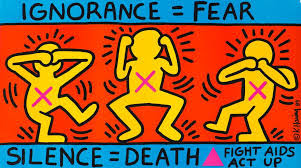
eminders of AIDS are all around me as I sit in my home workspace, a windowless room that I suppose was intended to be a dining room or maybe a walk-in closet. Just to the left of my laptop, at the edge of my desk are three playful block figures copyrighted by the Keith Haring Foundation. Think I bought them years ago in a shop in Portland. One of those charming spots filled with eclectic trinkets that will never cover the rent. Haring’s creations are always colorful and fun, the figures captured in motion. They make me smile. I think I bought these blocks to remind me to be playful with my writing (maybe not at this particular moment) and to celebrate simple things like an impromptu dance or a chance to pet and perhaps calm a barking dog.


But Haring’s art also represents my gay identity. I used to have a Keith Haring backpack, a look-at-me-I’m-a-proud-fag symbol. People would stop me in the streets of Amsterdam or at a hip cafe Seattle and comment on it. “Keith Haring, right?” Yes, yes. They’d smile and offer a knowing nod. Translation: You’re gay. It was my old-school version of Grindr. Gay man two metres away. (That’s what Grindr does, right? I’ve only seen it while peeking over a friend’s shoulder years ago as he looked at his phone while we were in a gay bar in West Hollywood. “Oh, my god, everyone in here is on Grindr!” he said with a sense of excitement I found odd. As with most technology, I didn’t get it. This was a gay bar...why did we need an app to tell us that the guys around us in too tight t-shirts or no shirts at all were queer?) Alas, my backpack had its glitches as a Grindr substitute. The people who stopped and commented were always artsy women. I suspect the gay men always crossed the street as I approached.


My beloved Keith Haring backpack is long gone. One morning, as I was writing in a regular cafe—sigh, I miss writing in cafes—my backpack disappeared from the foot of the chair where I was sitting. A homeless person who’d come in ostensibly to use the restroom brushed past me and took off with it. I suppose he needed it more than I. Maybe he even got lucky a time or two.


I’ve always loved that Haring’s art is so accessible. He knew this and used this to create iconic messaging during the AIDS crisis, making people look when they preferred to look away.
Haring died of AIDS-related complications in 1990, thirty-one years ago this month, for him an entire lifetime ago since he was thirty-one at the time. Googling that fact right now feels like a sucker punch to the gut. I’m winded. Again, short breaths. That’s all I can manage.


To my right are four Post-its, their non-sticky parts rising up from my desk surface. A small blue one has the name of the actor/director who’d succumbed to AIDS. I wanted to write a blog post about him. I might not have noticed my scribbled note for another half year. For me, I see a Post-it for a day, maybe two, and then it loses its intended powers of reminding. Little thoughts, things that spark a creative idea in the moment, can quickly be forgotten. Not so, the big things. Like AIDS itself.


There are also a half dozen notes written on torn off pages from three different notepads—a note about querying, a writing to-do list from a month ago (the items still not done), an idea for a novel that I must have thought was brilliant when I jotted it down but now it seems like not much at all. I keep it in the open, hoping that, whatever sense of genius I had felt when I madly wrote it, circling words and adding explanatory arrows (which now explain nothing), will miraculously return on a later glance. Not today.


One of the other pages lists possible ideas I could write about for a regular essay column about relationships in an American newspaper. The first idea is about Stephen, my assigned buddy when I was a volunteer with AIDS Project Los Angeles (APLA). Had he not died of AIDS-related complications at twenty-nine in 1992, he’d be fifty-sev
en today. Sweet, sweet man with big, big dreams. Dreams unfulfilled. The second essay idea on the list is about my dear friend Richard whom I met as an APLA volunteer, who talked me out of wanting to commit suicide when my first love cheated on me with a friend of mine and these two dickheads decided they wanted to make a go of things. Richard often marveled at how he made it through the AIDS crisis as so many friends and lovers around him died. Sadly, Richard died five years ago of brain cancer, still much too young, but he knew the extra quarter century he got was a blessing.


On the side of my four-drawer filing cabinet—yes, I still have such an outdated storage device—is a much crumpled note tacked up with a magnet. It lists background facts and passions of my friend Farrell, my tennis and margarita pal from my days in Dallas. I remember the time I showed up on court after margaritas—happy hour with the nuns I worked with—and, after five minutes of hitting the ball, he just stood on the other side of the court and laughed. Apparently, margaritas are indeed an energy drink, but in all the wrong ways. I dutifully retrieved the two cans of balls I’d managed to send over the fence and we sat and talked on a bench until it got dark. Back then, I didn’t know Farrell was gay and he didn’t know I was. He came out in a letter after I’d moved to Malibu, sensing a coldness when he flew out for a visit and concluded that it had to be because I’d figured out he was gay. We are so sensitive and so capable of misreading signs when we’re closeted. That coldness was law school stress that I stupidly hadn’t shaken, a nice visit unduly compromised.


That crumpled up piece of paper is supposed to help me design an AIDS quilt panel in m
emory of Farrell, the sizing and required materials written on the back. He died in 1995. I found out when a card I’d written to him was returned unopened to my address in Vancouver, a red postal stamp reading: DECEASED. I hadn’t put things together until then and Farrell didn’t share with me. I knew he’d lost his accounting job in Dallas, which could only have been due to illness or discrimination. Farrell was the most dependable person I knew. He’d shared that he was volunteering with the Dallas AIDS Resource Center. That’s the last I heard from him. A very reserved, proud man, I fear Farrell died alone. He’d been adopted and all his relatives in New Orleans had predeceased him. I don’t really have the means of making a quilt. I don’t have the craft gene. I don’t even have the holding scissors safely gene. This project intimidates me. The desire is there along with the sense that, if I don’t remember and honor Farrell, no one will.

Yes, AIDS is still all around me. The reminders are small and quiet. Some days, I don’t even see them. On other days, like today, I’m hit first thing and I know its shadow will hang over me until bedtime.


Small breaths. I’m so lucky I can do just that.


Thursday, November 12, 2020

BOOK REVIEW: THE PRETTIEST STAR


For starters, I'll admit that I long to read more fiction set during the days of the AIDS crisis. There's so much inherent drama and tragedy in a time period when many thought that the deaths of young, gay men were a sign of God's wrath. The stakes were so high, the tension easy to draw upon. Still, it takes a skilled writer to craft a compelling story arc with diverse characters.


The Prettiest Star (Hub City Press, 2020) begins in New York City and I settled in, looking forward to reading about gay life in The Big Apple as AIDS crashes the party. Thus, I was startled when things soon shifted to small town Ohio, the story moving forward from the perspective of young Brian's mother, Sharon, and his fourteen-year-old sister, Jess. Sharon is deeply religious and the town is a conservative place where people rarely venture too far afield. (Sharon's never been on a plane.)


After a six-year absence, Brian writes a letter to his parents, saying he has AIDS and wants to come home—for how long, it's unclear. Neither Sharon nor Brian's dad, Travis, is keen on the idea. What will the rest of the family think? What will the town think? AIDS?! Is it even safe?


Author Carter Sickels does a masterful job in capturing the sentiment of the time—the fear, the ignorance and the sobering reality that being gay was still a source of great shame and hatred. He also shows that he has done his research on AIDS, describing how it overtakes Brian with specific symptoms and pride-busting humiliations.


Lettie, his grandmother who has always adored Brian (and who isn't given enough credit about things she knows), is a vital force, diving in and supporting Brian and offering a model of love and acceptance for the more tentative (and more torn) Sharon and Jess while also standing up to the hate from the people of her church and town. This isn't her story (nor is it that of Brian's brash NYC friend, Annie). Lettie and Annie are 100% Team Brian. They don't have much growing to to.


Brian though must come to terms with the death of his partner and his own full acceptance of being gay—it was so much easier in the city—while now having AIDS. Jess, a self-conscious teen, is often embarrassed by her brother whom she used to adore and follow like a puppy dog. It's hard for her to be noticed much less heard. Sharon, a preacher's daughter, has the most growing to do. She's got a husband who can't accept what Brian's become and who can't stand up to his loud, homophobic brother. Travis is basically AWOL. Sharon could lean on Lettie, but there's an undercurrent of jealousy there, Brian always seeming to have an easier relationship with his grandmother; she could confide in Annie, but Annie's just too out there, nothing like what anyone's used to in small town Ohio.


At times, I wanted more of Brian's voice. I suppose I hoped for more direct conversations between him and his mother, but Sickels opts for more realism than drama. Much of the ongoing tension within any family comes from all that remains unsaid. It's a challenge to write from three points of view (Brian, Sharon and Jess) and Jess's perspective feels a little too insightful for her age. Sure, many teens are "wise beyond their years," but even the way things are phrased doesn't sound like a teen's voice. It's a minor criticism when the story is so well told.


The Prettiest Star brings back to mind so many things I had forgotten about AIDS in the 1980s. To be sure, for a long time, I wanted to forget. Now, however, I need to remember and this novel helps to do just that in a compelling way.

Tuesday, July 16, 2013

MALIBU DÉJÀ VU

Twenty-three years ago, I drove into Malibu for the first time, laughing over the fact that this was where I would go to law school on full scholarship. Some gig.

I remember being somewhat disappointed that there should be a KFC on Pacific Coast Highway in the business section of Malibu. (Actually, it was Kentucky Fried Chicken. This was before the Age of Texting and reducing everything to initials.) I was also peeved that Olivia Newton-John wasn’t waiting to personally welcome me. In fact, I never met her even though a law school friend rented a space in the home next to Olivia. During my two and a half years of law school, I had to settle for chance encounters with Rick Springfield, Jon Lovitz and a personal fave, Bob Newhart. I always gave them their space. That’s just how Malibu folk treat one another.


Technically, I only lived in Malibu—on campus—for one semester before getting an apartment up the treacherously windy Malibu Canyon in lowly regarded Calabasas before moving to another coastal community, the boutique village of Pacific Palisades. Still, Malibu was home base The Law School Experiment.

I drove to Malibu from the north today, saddened at first by the scorched mountainside vegetation from recent wildfires. Nonetheless, the more remote coastline induced awe as I gazed at the gentle turquoise Pacific waters, a disappointing status for the black speckles that represented surfers lolling on surfboards.

A lot has changed and yet nothing has changed in the years that have passed from my stint amongst the wealthy. Malibu’s population remains at 13,000, unlikely to ever climb due to building restrictions, mountainous terrain and, well, forest fires. Much of the core area of Malibu business has changed. Not so much the structures, but the signs. Pizza Hut, Ben & Jerry’s, the deli where I always ordered mac and cheese and the video store where I ran into the incomparable Suzanne Pleshette’s TV husband are all gone. My bank is now a medical clinic. Even the Hughes Market grocery store is now a Ralphs. (It pains me not to write Ralph’s, but the company has dropped its apostrophe. Maybe it too was a texting bother.)

The most tragic new sign is for Banana Republic. I’m neither a lover nor a hater of the chain. Take it or leave it. (Maybe that’s because the first thing I ever tried on back in the day when Banana Republic had a safari feel was a summer shirt that felt very strange in the chest. Turns out it was a women’s blouse. But nice peachy tones!) BR took over the struggling, yet sprawling women’s store once owned by my one of my first gay friends, José, who died of a brain aneurism fifteen years ago at the age of forty. My friend, Benny, and I used to pop in regularly to chat while voluntarily changing all the displays to make things look more inviting in a effort to increase sales. (Perhaps I was, in fact, the reason the business went under. What do I really know about fashion? Recall blouse incident, above.)

But for all the changes, there is plenty that is the same. Pepperdine University still occupies prime land on the edge of a mountain with insanely gorgeous ocean views. Most of the beachside pubs with subpar food remain open, again due to insanely gorgeous ocean views. John’s Garden still sells sandwiches with sprouts in the Malibu Country Mart courtyard beside the children’s playground. The public library remains with a spruced up facade, this being the place where I escaped the law school crowd to study across from a homeless man who soaked his dirty clothes in a white plastic bucket. We were regulars who never exchanged hellos but allowed for one another to peacefully coexist.

I’m still laughing as I sit in the courtyard and watch people pretend to be locals. I was a great pretender. Why did I ever move? A nagging voice inside my head chants, “Dumbass”, but it was not a practical commute to downtown L.A. or to my subsequent job in a small Santa Monica law firm where I had a perfect ocean view that included the Santa Monica Pier. Yeah, left that, too. Once again: Dumbass.

When you are young(er), you don’t fully appreciate each moment. This is perhaps the biggest reason I am back for a month, even though I am staying in West Hollywood instead of a preferred coastal area. My five years in L.A. ended with the Rodney King riots (during which my car window was shot out as I drove) and the Northridge earthquake, but there were great times before all that.

L.A. is where I fully came out. It is where I fell in love the first (and second) time. It is where I learned how to do something constructive in response to AIDS and where I listened to my buddy Stephen talk of his unfulfilled Hollywood dreams while he bravely kept his resolve to break in once he conquered AIDS. This is where I met many good friends, many of whom still live here. In fact, I have more friends still in L.A. from my brief stint two decades ago than I have in Vancouver from the nineteen years since.

I am back, if only temporarily. Laughing once again.