Showing posts with label happily ever after. Show all posts

Tuesday, January 9, 2024

MY ROM-COM RENAISSAINCE


Back in the 90s, I adored, romantic, comedy movies. They filled me with hope. They reminded me that, despite what I saw in the gay community, love was possible and, yes, it was worth waiting for. It could still be an aspiration. 

Even when the movie was a cookie cutter copycat of a Julia Roberts or Meg Ryan movie, even if the knock off still starred Julia Roberts or Meg Ryan, I still left the movie theatre with a broad smile on my face. These movies were sweet confections that went down so easily.

Until they didn’t. 


My disillusionment with the romantic comedy came at a time when the fairytale relationship I found lapsed into a nightmare. Darkness replaced light and I felt trapped. 


On the rare occasion when I would allow myself to watch a rom-com, I no longer smiled. I felt bitter. These movies had set me up with false hope. Life was more complicated, much harsher.

I became a cynical viewer. I poked holes in the light plots, like an armchair quarterback yelling at the screen as his beloved Cowboys were intercepted, fumbled and got all-out whooped.


“Yeah, right.“ 


“Get real.” 

“Not buying your bullshit.“ 

The sticking points that threatened to undo what looked like a blossoming, cinematic relationship were too easily resolved. Happy endings seemed contrived.

My conclusions were not unreasonable. The expectation upon watching a rom-com had always been that reason and reality were tinkered with, any nods to them played out lightly and loosely. I could no longer suspend disbelief for a ninety-minute sugar rush. Deep in survival mode, I anything light or loose taunted and mocked me. Any attempts at escapism were futile.

Almost two decades after getting out of my abusive relationship, I still couldn’t bring myself to return to rom-coms to give them another chance. 


I tried another option. I read a few romance novels. Usually, this experience did not go well. I could not find enjoyment. Too much fantasy. Too little reality. Worse, I could never buy into the complications that arose in the plot. A romance novel, by its very structure, requires a happy ending. I could not muster up any suspense. Every obstacle would be overcome, no matter how insurmountable the author had set it up to be. I would dutifully read through until the end, always being in a state of disbelief, despite never buying into any aspect of the story.


And then, for reasons that still astound me, I began to consider writing my own romance two years ago. I’d write a little, then walk away from it. Let it breathe, I told myself. But I knew there was more reason for my avoidance. Who was I to write romance? I wasn’t a believer in fairy tales. Not anymore. I’d fallen in love a few times but never with a happily ever after. How dare I give a reader their own sense of false hope? 


Still, during my breaks from that writing project, I would pick up the occasional romance novel, giving the genre another try. I attempted to let down my guard. Let it just be a nice story. Often, I found myself wanting to give the book a radical edit. If I just tear out these fifty pages of “complications,” I can get to the ending. Let us all be happy. 


Relax. I did not deface or destroy any part of any book. I just sighed a lot. Loudly. And not in that Meg Ryan diner scene kind of way from When Harry Met Sally. My neighbor seemed to tolerate my reading behavior. The police never showed up to investigate a noise disturbance. 


Maybe I’d never be able to embrace rom-coms again or binge-read romance novels on a dateless weekend. I could break up, once and for all, and move on. "Sorry, genre. It's not you; it's me." 


Let somebody else enjoy them while being in a period of feeling hopeful and aspirational about love and relationships, as I once was.


In time, even I could see my resistance was overblown. I’d fallen in love two more times since the Very Bad Relationship and the second one is still going. (This is when I hear RuPaul in my head, dropping a certain Drag Race meme.) If I could believe in love again in my actual life, why couldn’t see it again in fictional representations?


A few months ago, I took a big risk. I pulled Meg Ryan out of the vault. I pitched to my boyfriend, Evan, that we watch Sleepless in Seattle. It was research I told both him and myself. The romance project I had been working on, off and on, was set in Seattle. One of the things that I’ve been wanting to do in the manuscript is to pay homage to that movie, bringing back some of the more memorable settings in the city, and having the events in my own novel play out in a more tragicomic rather than meet-cute manner.


Um...is there such a category?

Evan is neither a reader of romance books nor a viewer of rom-com movies. A Netflix night for us does not involve much chillin’. It takes extensive negotiation. He suggests zombies and cowboys or the wrong Ryan—not Meg, not even Mr. Reynolds or Mr. Gosling, but Mr. Murphy, whose work long ago lost its G/glee. The way I conned/coerced him into watching Sleepless in Seattle was that, since he had much more experience living in Seattle, he could identify the public settings more accurately than I. Being the wholehearted supporter of my writing that he is, he sat down and watched with me. A true trooper. His first viewing, my umpteenth.


He’ll deny it, but he liked it. And so did I! 


Oh, Meg, how I’ve missed you. And you, too, writing goddess, Nora Ephron! I didn’t spend my time pointing out the many absurdities in the plot or projecting shame onto Meg’s Annie who was tracking down—even stalking—Tom Hanks’s Sam while engaged to Walter (Bill Pullman), an affable, stable, nerdy man whose biggest “flaw” is he has allergies. I bought into all of Annie’s sparkly hope, I loved Rosie O’Donnell’s nudging as her bestie, I rooted for Sam as he got “Back in the Saddle Again” (yes, the song played), giving dating another go, and I cheered as Sam’s young son, Jonah, pimped Pops to Annie. There is no wooing between Sam and Annie. They never go on a date. They don’t have a bad breakup, only to get back together again. Nope. They just end up at the top of the Empire State Building on Valentine’s Day so we know they will live happily ever after. A cute old-timey Jimmy Durante song playing over the credits cements our feel-good vibes. Ahh, love!


A couple of weeks ago, Evan suggested we finish a nice day with Netflix. I tensed for the typical back-and-forth bidding, his Scarface versus my Rustin, his Riverdale versus my Maid“You pick,” he said. “I don’t care.” Huh? Battle-weary even before the first round.


I called his bluff. “How about You’ve Got Mail?”


To be honest, I’d never loved this movie, even when I lapped up rom-coms. [SPOILER ALERTS.] Maybe I never saw the reason to make some bigtime business tycoon likable. Maybe I couldn’t handle seeing a charming little children’s bookstore close. Opening such a store had long been a dream of mine. How could a happily ever after not include the store’s survival? Goliath wins…where’s the feel-good in that? But, watching with Evan, I felt it best to suppress any objections. He’d let me pick, after all. I didn’t need to feed him with examples of the movie’s weaknesses. I needed to block any possibility of zombies being part of our next movie night. So I watched less critically.


Gosh golly, I really enjoyed it. Meg can do anything! She’s an actress with all sorts of cutesy tics that make her adorable and make her perfect for rom-com roles. There’s a skip in her step (even when she’s standing in place) that exudes positivity. She’s got what Mary Richards had on The Mary Tyler Moore Show. In the pilot episode, Mary’s future boss, Lou Grant, interviews her. “You’ve got spunk,” he says. Then, after a beat: “I hate spunk.” (Click on the link. The interview is wonderfully written.) In all Meg Ryan’s rom-coms, she believes in love and sees goodness in the world. She adds just enough tiny frowns to make the sweetness go down smoothly without resulting in a sugar coma. 


Evan liked the movie, too. Toward the end, his eyes may have even watered up. No doubt, a reaction to something in my stuffy condo. An allergy perhaps, but nothing on the level of Walter’s sensitivities in Sleepless. A keeper, that Evan. 


It seems that watching two rom-coms with a guy I love has allowed me to love the genre again. I can stop resisting on behalf of all the jilted. I can hope for happy endings again. Maybe I can enjoy a romance novel without the urge to rip out huge chunks. Maybe I can gain momentum with my own manuscript. Maybe I can just let love be—on the screen, on the page and in real life.   


Monday, January 30, 2023

ROMANCE PROBLEMS


I don’t often blog a review about a book I can’t recommend. As a writer who has had a book published, I’m well aware of how any and every bad review can sting, whether in The New York Times Book Review or as a one-star comment on Goodreads. Sure, one weighs more than the other, but I still would be upset if Tamara in Tallahassee thought my book sucked. I want to support writers, I want to be part of getting people excited about reading, I want to stick to saying nothing when I don’t have anything nice to say.


But I make exceptions.


Sometimes even nice people are driven to react. 


It’s not that I hated Red, White & Royal Blue. It was okay. Mostly. The last fifty pages were, frankly, painful. I kept putting it down. Please don’t make me read more. Please make it go away. There’s no harm in being injected with sugar water, but there’s no merit either. To repeat, I didn’t hate it. I just wanted to tear pages out. Seriously. But it was a library copy. I don’t damage library books; I won’t even dog-ear a page.  


This isn’t going to be a review, after all. Instead, the book serves as an excuse for me to wonder about my place in the publishing world, to question who can/should write gay characters—if there is, in fact, still a place for them on pages—and to give romance readers a bit of a shake.


My first book was published in 2008. Middle grade fiction. It did all right in terms of sales for a smaller Canadian press. All copies eventually sold and the publisher told me they wouldn’t run another printing. You can still get an e-copy here. If you do so, I encourage you to stay silent if you don’t like it. Alas, you won’t be able to tear pages either. 


It’s my only book so far, but not for lack of effort. I’ve completed several manuscripts in various genres but no more book deals. I’m a one-hit wonder, but that probably stretches the definition of hit. One manuscript I’m particularly proud of is called Dead in Gay Years, a humorous comeuppance for a onetime gay god who’s suddenly dumped and is now a forty-something with a dad bod and no prospects in dating, in work, in anything. 


I
t’s been hard to query to agents. LGBTQ fiction is considered a niche market and there’s not a demand for books by gay cisgender white men. I’m told that status makes me “privileged” even though I spent most of my life feeling oppressed. I hid and “passed” (as straight) to minimize bullying. I feared death from AIDS. I worried about losing my job or my credibility as a teacher and then a principal. In “safe” environments such as gay bars, I was shunned as so many gays artfully perfected blank stares that looked through me in order to eye up someone hotter, sexier, a worthier conquest. At no point did I feel that being a white gay man was a privilege and yet now outsiders have deemed my life as such. I’m lumped with all other guys who are white, gay and cisgendered. There is no effort to consider how different I actually was.


I realize non-white, non-cisgender queer people always had greater struggles, but our community continues to be divided, both internally and externally. Apparently, I had it good. 


For my next manuscript, I’m considering a gay romance. It’s a calculated decision. Book deals are business decisions and M/M romance sells. Ironically, most M/M romance writers are women, often opting for gender-vague names like Chris or Kelly or choosing to use initials instead, à la J.K. Rowling or J.R.R. Tolkien. Then again, it seems most M/M romance readers are women. Presumably, they don’t need to read gay male characters from an authentically gay male viewpoint. Characters arising from a female connotation of a gay male might be are just fine.


That’s a lot of background—and ranting—to explain why I gave Red, White & Royal Blue (St. Martin’s Griffin, 2019) a try and forced myself to finish it, leaving all pages intact. It’s written by Casey McQuistin—yes, a woman—and it’s doing extraordinarily well. I’ve seen several agents specifically say, “I want the next Red, White & Royal Blue on their wish lists. I needed to see what all the fuss was about. I hoped to come away from it and say, “Yes! I can do this! I can be the next Casey McQuistin”…only with a penis, some pesky ear hair and a looming colonoscopy appointment I keep putting off.


From the outset, I didn’t like the premise. I found it ridiculous. The novel is about a romance between a prince in the British royal family and the First Son of a U.S. president. Prince Harry and Donald Trump, Jr.? Okay, I just made it icky. The story doesn’t strive to aggressively offend readers. Still, as far-fetched as the premise is, it’s also too cute, too convenient.  


As I struggled to stick with the book, I kept wondering why romance novels so often focus on royalty. If we’re so concerned with labeling people as privileged, why continue to spin tales about Prince Charming? Do we not grow beyond who we were at five years old, listening to parents and kindergarten teachers reading us picture books with princes and princess? Don’t we get past Disneyfied tales involving Cinderella, Princess Elsa and Ariel? 


While agents say they don’t want stories wherein the prince saves the princess, I’m not sure it’s progressive or even feminist to be falling for princes under any circumstance.[1] Assuming they are filthy rich, there’s still an aspect of being rescued. Pay my mortgage, sweet prince! Or, at least, both our dinners. Royal stories will always seem old-fashioned because monarchies are outdated. With the passing of Queen Elizabeth II, aren’t most of us done with the notion of a British monarchy or any monarchy? I write fiction, but I strive for it to be realistic fiction. I can’t stomach writing (or reading) romance that’s pure fantasy. 


Casey McQuistin can rest assured, I’m not going to dethrone her, even if some agent or editor finally decided to take a chance on another—yawn—gay, white cisgendered male author. I can’t possibly write about royal lives unless there’s a humiliating dethroning. I wouldn’t bring back the guillotine scene, but the once-beloved, never-to-be James XXVI would go through a spell of rationing generic peanut butter and saltines and maybe I’d throw in bed bugs and gonorrhea out of spite. (Weren’t royals plagued with STDs? Why doesn’t that factor into the royal romance trope?) 


In general, I struggle with the romance genre because of the insistence in having a Happily Ever After. Of course, I root for protagonists. I want them to resolve the problems authors throw at them to keep us reading. However, I don’t ascribe to the rigid belief that finding everlasting love (or even a happy-for-now love scenario…hello, sequel) is the only way to have a happy ending. Romance novels continue to propagate a pervasive bias that being coupled makes life better. A person, real or fictionalized, can be happy, single or attached. 


Romance lovers say, Fine, sourpuss. Write your damned story, without princes or weddings or an ending with a couple kissing on a beach in Fiji. It’s just not a romance novel. And, hell no, I’m not going to touch it! VD is for Valentine’s Day, not venereal disease. 


Fair enough. Reading is often another form of escapism, but I wonder what harm it does. The romance book market remains robust and readers eagerly lap up one romance after another, happy-coupled ending after happy-coupled ending. Surely, it feeds into hopes and expectations of the same in readers’ actual lives. Where are the stories of triumph in going it alone or breaking free from a mismatched, perhaps even harmful relationship, ending not with the character jumping into another, seemingly healthier relationship, but finding comfort and confidence in going forward on their own, happily ever after or, at least, happy for now? We have a massively popular genre of literature that won’t even consider that as a viable option. 


Did I say I’m considering writing a gay romance? It’s a stretch, for sure. This post might make it seem doubtful, but I can do happy. I can get in the right frame of mind with a playlist that includes “Shiny Happy People” and this song but certainly not that song. I’ll leave out the bed bugs. No castles nor crowns either. If there’s a Prince, it’ll be the beagle. The closest I’ll get to charming is the brand-named toilet paper that leaves off the last letter. Maybe I’ll even publish under a gender-ambiguous first-name pseudonym like Pat or Jordan so no one is turned off knowing the M/M tale was penned by an actual dude. 


Look for my book on Amazon, at Barnes & Noble and on indie store shelves in 2026. If my title should indeed appear in any or all of those places, that will be my real-life happily ever after.


[1] Male primogeniture, favoring younger sons over older sisters, wasn’t done away with for the British monarchy until The Succession to the Crown Act of 2013, the amendment applying to births after October 28, 2011, thereby keeping older cases of gender discrimination intact. Thus, Charles’ sister, Anne, born in 1950, is 16th in line to the throne while her younger brothers Andrew (b. 1960) and Edward (b. 1964) are 8th and 13th, respectively. (Based on the “enlightened” 2013 act, Prince William’s daughter, Charlotte (b. 2015; 3rd), now falls between older brother, George (b. 2013; 2nd) and younger brother, Louis (b. 2018; 4th).) It’s not that Anne will ever have a shot at becoming queen but rather that her status is diminished due to gender, a practice perpetuated for centuries. Why would women romanticize royalty?

Monday, February 7, 2022

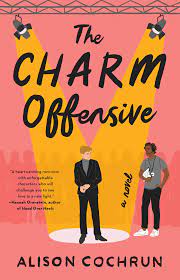
THE CHARM OFFENSIVE (Book Review)


By Alison Cochrun


(Atria, 2021)


I’ve watched too many seasons of both “The Bachelor” and “The Bachelorette.” 


I will try to redeem myself by saying I’ve stopped. Haven’t watched for several years. I can thank Colton Underwood. He was a football player who never quite made the NFL and was a contestant on a season of “The Bachelorette” but ultimately got sent home in the rejection limo. Then they made him guy women would woo on “The Bachelor.” I bowed out. The guy was incredibly dull and I didn’t want to watch a whole season that would focus on the fact he was supposedly a virgin. As it turns out, he was gay.


Alison Cochrun’s The Charm Offensive is a gay romance set during a hetero-focused season of “The Bachelor.” Correction: a season of the fictional show “Ever After” which is different in name only plus a few cosmetic tweaks. Cochrun’s reality show plays up the fairy tale factor more blatantly with Charles Winshaw being the show’s Prince Charming who actually wears a crown to meet twenty prospective princesses. What’s shocking—SHOCKING!—is that Charlie hasn’t gone on the show to find love. He’s a wealthy tech genius who got booted from his own company and is trying to rebuild his reputation so he can re-enter the field. 


Because geeky tech companies in the Silicon Valley seek hunky Prince Charmings. Surely that’s on the job posting for app creators and game designers. Maybe the way to take a chunk out of Facebook (or that stupid “Meta” rebrand) is to hire a figurehead who’s easier on the eyes than Mark Zuckerberg. It’s possible. I know nothing about tech.


The fact Charlie isn’t looking for love doesn’t sit well with Dev Deshpande, an “Ever After” producer assigned to manage its star. Dev’s been with the show for six years, having watched it since he was ten, fully enrapt with the idea that people can go on the show, fall in love and live happily ever after. Even though most of the relationships don’t last, Dev is still married to the idea that the show offers the potential of everlasting love. As the new season begins, Dev’s trying to build himself up again too, having recently ended his six-year relationship with Ryan, another producer on the show. Ryan had always said he wasn’t looking for longterm; Dev just chose to believe he could will his own ever-after onto them. 


Charlie is an awkward reality star. He’s got the good looks—blond and impossibly handsome—but he can barely form a sentence under pressure and his OCD makes him reticent to human touch, a huge problem on a dating show with multiple women vying for his attention and affection. 


The book becomes more implausible than the show upon which it’s based when Dev ends up working 24/7 by living in the same house as Charlie. (What kind of employment contract did Dev sign?) Jules, Dev’s best friend who also works on the show, suggests that Dev get Charlie to relax more on the filmed dates with the women contestants by taking Charlie on practice dates—not between Jules and Charlie, but between Dev and Charlie. 


Um, what? 


Charlie goes along with it because, well, isn’t that what any ridiculously good-looking straight guy in his late twenties will agree to do so he can improve upon dating women whom he’s not really interested in falling in love with? 


Are you following? If it seems nonsensical then, yes, you’re following.


Just go with it. I managed to. I’m telling myself it’s because reading The Charm Offensive was my way of getting another taste of “The Bachelor” without committing to a whole maddening season of cat fights, limo cries and icky Fantasy Suite dates where we’re led to believe the guy has three consecutive nights of sex with the final three women. God, I really watched that show. Season after season. And somehow it made me believe in the possibility of love. Shame on me.


Cochrun’s Charlie has anxiety in addition to OCD. He’s also not sure about his sexuality and parts of his journey to figuring that out feel like information dumping as possibilities are explained to him (and the reader). It didn’t bug me since Cochrun chose to bring something different to the romance genre. She ups things by making it so that Dev also deals with mental health issues. Being as I have mental health challenges too, I welcome seeing this in the main characters instead of in a supporting character. (The story progresses in alternating chapters, told in third person, from Dev’s point of view and then Charlie’s point of view.)


Cochrun takes liberties from reality in having every “Ever After” staff member be queer other than its creator. All the queer employees have something good about them. The straight character is a villain. I never got a feel for any of the supporting characters. I expected Dev’s ex to have more of a storyline, playing on the inherently awkward circumstance of Dev and Ryan continuing to work together after a not-so-great breakup. Ryan is only used to advance the plot instead of to create conflict. This felt like a wasted opportunity. The story, as written, is all about Charlie and Dev.


You can guess how things go. It’s a gay romance, folks. Happily ever after is how these stories have to end. Knowing this, it felt like the story went on longer than it needed to. Cochrun had to stick with the show’s structure, with the group of twenty women getting narrowed down to one over two months’ time. Connections happened too soon and the ensuing barriers, miscommunications and jealousies seemed trivial. There’s nothing particularly wrong with The Charm Offensive; I just wanted to get to the predictable ending fifty pages sooner. 


The book is better than “The Bachelor” because it’s willing to acknowledge that a dating show about finding love may not actually be about finding love. Stick with romance books instead.