Tuesday, October 10, 2023

CLICKING ON


My birthday happened. A friend emailed me the week before to make plans. A dinner. The message included, “Is this a big one?” I knew what he meant and, no, entry into a new decade is still a year away. “Don’t rush me,” I replied. Still, at my age, they’re all big ones in terms of numbers and they all seem to be rushing me. 


Another birthday? Already?! Pick any random smaller number—27, 35, 43, 52—they came and went so fast. How do I slow the speed setting on this treadmill of life?


Alas, the speed setting is locked. And so, yes, another birthday, another number on the age clicker. 


I’m not a birthday guy. It has nothing to do with bigger numbers. Sometime in my early twenties, I started letting Happy Birthday messages go straight to the answering machine, a gadget that sounds as ancient as the telegraph and messenger pigeons. I can’t cite a particular birthday, but I suspect I go into hiding on my “special day” because I was disappointed with how it was or wasn’t celebrated once or twice. Was it the pair of socks my grandparents gave me when I was eight, ignoring my wish list which included Lite-Brite and the gender inappropriate Easy-Bake Oven? Maybe it was the Hardy Boys book they gave me the next year and the year after. So boring. So many words. (I was a very slow reader.) 


I shouldn’t blame my grandparents. Their gifts never dazzled, but they did have a nice tradition of buying a little something for the other grandchildren when it was a different sibling’s birthday. Pez dispenser? Pet rock? I don’t remember. Maybe that’s what the socks were, a non-birthday consolation, and my sketchy memory has made argyles the main attraction. 


Someone that mattered probably missed a birthday. Probably a whole cluster of friends. My guess is it was part of leaving university as all my Forever Friends started new lives in Boston and Tulsa where new jobs and, yes, newer friends made the birthdays of friends from college easy to forget. We didn’t have Facebook sending us reminders. We didn’t have calendars on phones or laptops. We had to open up address books every January and write all the birthdays on wall calendars that celebrated “The Far Side” or Miami Vice or Vermont. Some of us prided ourselves in how many birthdays were committed to memory along with phone numbers, state capitals and all the actresses who played on TV’s Charlie’s Angels, in order of appearance and ranked (#TeamKateJackson).


The Swedish cinnamon bun,
aka kanelbulle.

Whatever the genesis for shunning my birthday, it’s now entrenched. I go into hiding which isn’t as bad as it sounds. Usually, it means I go on a solo hike—a treat in itself—or head out of town…in recent years to the Oregon Coast, Seattle, Victoria or Stockholm. (The Stockholm trip was three weeks and the birthday being smack in the middle of it was merely fortuitous. It meant an extra kanelbulle on another day of being gloriously ignored by Swedes.)


This year's birthday escape:
a glorious, seven-hour hike. 

I spent one birthday in a psych ward. It was a little too anti-birthday, even for me.


Aging has been on my mind more than usual the past couple of months and not because my local drugstore sent me a $5 voucher, saying, “We wanted to celebrate with you.” (A virtual celebration with a drugstore sounds sadder than argyle socks but, yes, I’ll take the free shaving cream. Begone, gray whiskers!) 


The truth is, I don’t feel older. I continue to contend my body and mind are aligned with thirtysomething. It sounds so much better than any other decade-something in part because I adored the TV show way back in the ’80s. (Good god, I just Googled the cast and they’re all sixtysomething and seventysomething. Duh…but still a shocker. It seems only Paul Rudd and characters in comics don’t age.)


These characters drink heavily
from the fountain of youth.

I get a reality check whenever I leave my condo and have quick, casual exchanges with people who don’t know me. I’m just the guy in front of them, waiting to order my oat milk latte or the person they’re trying to get past as I hunch over and eyeball Häagen-Dazs pints in the freezer aisle at the grocery store. Three words set me straight: “Excuse me, sir.” 


Okay the “excuse me” is fine. Nice manners. Better than a sigh, a grunt or a shove. But it’s the “sir” that feels like an assault. Did they say that as they maneuvered by the skateboard dude on aisle three? I may feel one age, but clearly I look another.


I mean, good for Colleen
Hoover, but what about
the rest of us?

For practical, non-vanity reasons, that’s a concern. I worry I’m aging out of my big career dream. I yearn to have another novel published. Actually, many novels. Move over, James Patterson and Colleen Hoover, I want a spot on the shelf, too. And off the shelf…grabbed by an avid reader, scanned at the register, taken home, read and loved…or at least liked enough to evade those crushing one-star reviews. (Who are these terrible people? Weren’t we all taught, If you don’t have anything nice to say…?)


I’ve been querying agents by email, my cover letter and first five pages ending up in virtual slushpiles and thereafter, it seems, passing through the virtual shredders. No response means no thanks. 


I shrug it off the unspoken dismissals. I remember all the men who rejected me. All the messages sent on dating sites, never answered. All the coffee dates that went nowhere, the few promising ones seeming so only from my perspective. I know rejection! I handle it well! 


But I don’t want to. I want an agent to finally say yes. Actually: “YES!!!” I generally think extra exclamation marks are redundant. Normally they cause involuntary tics. But bring ’em on, dream agent. Exclaim! Exclaim! Exclaim! Take all that love and enthusiasm to Random House and HarperCollins and land that book deal. Let me be your golden nest egg! 


Oh, how I dream. 


Let me continue to do so.


My best shot to getting an agent to consider my latest manuscript is to have their full attention, face to face, instead of being one of a sixty querying emails they power through on a Saturday afternoon before they get to do something more appropriately Saturday afternoon-y.     

Two weeks ago, I attended a writing conference in Seattle and pitched three different novels to three different agents. Each pitch was in one of those hollow hotel conference rooms with oversized beige drapes, beige tablecloths and a carpet adorned with rust-colored flowers and swirls intended to cover at least twelve years of wine and coffee stains. (No stains from me; I did, however, spill a quarter bag of flax pumpkin granola while waiting in an armchair in the lobby. Sorry!) 


My in-the-flesh face time with each agent amounted to four minutes each.


Bing!


A timer and some watchful volunteers made sure we’d vacate our chairs posthaste.


The first impression was everything. With eighty wannabe authors entering the pitching room at the same time—it was one of four such sessions—I needed to stand out for all the right reasons. For days, I sharpened my spiel. I timed myself, whittling things down from a rambling seven minutes to ninety seconds, the time recommended to allow an agent to ask follow-up questions, assuming they didn’t scowl, wave their arm and say, “No agent for you!” 


While I knew the content of the pitch mattered most, I knew other things factored into an agent requesting pages and ultimately wanting to take me on as a client. I brushed my teeth in the men’s room. I popped a mint. I adjusted the collar of my conservatively stylish shirt. And I poofed up my hair which I’d had cut and highlighted the day before. No gray. Even the sideburns got a paint job. 


Please, let no one smile vacantly and say, “Thank you, sir.”


Let me look young. Younger, at least. If not thirtysomething, then fortysomething. I needed agents to see a long, bright writing future in me instead of my name on waiting list for Shady Pines.


LET ME BE YOUR CASH COW!!! 


Things went well enough. Two out of three agents requested more. We clicked. This time, the word click feels like a good thing. Maybe it will lead to something. This old-ish guy has so much more to offer.


Tuesday, October 3, 2023

THE DEATH SPIRAL


Okay, the blog is called Aging Gayly. While the aging is ongoing, the “gayly” can be a little spotty. It may have gone AWOL during a recent dark patch. 


I had a health scare in August, my body doing something for the first time. I did what any doofus guy who is squeamish and hates going to the doctor does. I ignored it. I hoped it would go away. A weird blip. 


The next day, my body did it again. It was more worrisome, not just because the issue hung around. It seemed worse. I did something worse than ignoring it. I Googled. Just a quick search, I told myself. If it got gloomy, I’d stop.


In less than three minutes, I’d found gloom. I stopped. I closed the tab and shut my laptop. But I’d already suffered gloom exposure. I couldn’t ignore that in the way I’d ignored my actual condition. 


I reminded myself of all the fine print on the info sheets that come with over the counter and prescription drugs and the possible side effects that fast-talking voice actors rattle off at the end of TV and radio commercials for medications. An ointment might be miraculous in removing a skin tag, but that result could be counterbalanced by some other pesky reaction. Rashes. Nausea. Seizures. Paralysis. Death. 


Death is always on the list. The grim reaper is one greedy bastard. How does a game of skin tag lead to You’re It? At least with the unsightly bump gone, the body will look decent for open casket viewings.


Of course, my worries were beyond fatal skin tags.


I called the doctor’s office to book an appointment. Usually, it takes six to eight weeks to get a slot. As it was August, I braced for a longer wait. My doctor was always off on bike or kayak trips in Italy or Greenland. I explained my symptoms to the receptionist and was slated to see Nurse Brian the next morning. 


What? So soon?! This seemed to confirm the gloom.


Hello, doom. 


Seizures. Paralysis. Death.


I made it to the doctor’s office. Nurse Brian was calm and professional. But then, his life wasn’t on the line. What was he…twenty-eight? As long as he avoided puffer fish sushi and acrobatic selfies on precarious hiking ledges, he had decades to go before intermittent thoughts of mortality.


Who's a big baby?
Yep, me.

Tests were required. Fasting first. I tried to suppress concerns about seizures, paralysis and death by fixating on my longstanding fear of needles. (I just Googled the term for that: trypanophobia. I got light-headed and had to lie on the sofa for five minutes. Seriously.) I walked to clinic the next morning, third person to line up outside before they opened. I needed to get the bloodthirsty stabbing over with. When it was my turn to give my medical info to the receptionist, she told me the requisition wasn’t in the system yet. “It takes 24 to 48 hours.” Not my time. Yet. 


I always reach this summit.

I shuffled home, relieved to avert being stabbed but frustrated too. Being a Friday, I’d have to wait the weekend, trying to suppress images of needles in my arm and thoughts of seizures, paralysis and death. I treated myself to a Last Supper of pizza and ice cream. Twice. And between meals, a pickup order of an item called the Little Mountain of Fries. I assured myself that a stomachache had nothing to do with my still-undiagnosed condition.


On Sunday evening, I went on a long bike ride to work off my jitters and the Kilimanjaro mound of French fries. I dealt with the lingering flash of Google gloom head-on. As an aging gay man, I’d lived a full life. I’d made it through the years of the AIDS crisis, I’d survived psych ward stays. I thought of people who died much younger. Life happens. So does death. If it was time to die, well okay. I’d pedalled my way through the five stages of grief: denial, anger, bargaining, depression…acceptance. It was a hollow victory.  


Come Monday morning I submitted to the medically sanctioned stabbing. I survived that much, even though phrases like “Your veins are hiding” and “I’m not getting enough blood” are guaranteed fodder for future nightmares. 


Naturally, my results were delayed as an ominous message on the medical portal stated my bloodwork had been referred to another lab. That can’t be good! 


I may have eaten my way through another French fry mountain. Everest conquered!


Whew!

In the end, it was all good. The issue did go away…after ten days. When I finally had a phone appointment with my doctor a month later, he had no concerns. The anomaly I experienced was “fairly common” and “normal.”


If only I were.  


Monday, September 25, 2023

KEEPING TWITTER FROM BECOMING "X"


There are many things that make me question why I’m still on Twitter. The new, ridiculous name is just one of them. It’s like the app is going through its awkward Prince/Puff Diddy phase. Just because Facebook is trying on a stupid name change doesn’t mean Twitter should follow. But monkey see, monkey do. These boneheads are billionaires?!


In truth, I’ve never really understood Twitter. A tech leader at work talked rhapsodically about it back in 2009. He was connecting with golf lovers in North Carolina and guys who gave insightful critiques on the latest software. Golfers! Techies! It was the pitch from hell. But my first book had been published the year before and I figured I could do some belated promotion or at least build a following for the next book release. (Sigh…still waiting.)


The way I remember it, the Twitter stream felt overwhelming. As I’d read tweets, the app would tell me there were 28 new tweets, then 56, then 140. How was I supposed to keep up? I rued dropping out of that speed reading class I took on weekends in high school. (The microfiche slides really did smell like vomit.) When I tried tweeting, I kept being dashed by the character limit. I had to be more concise in sharing my thoughts about the Beijing Olympics, Michael Jackson’s death and Adam Lambert on “American Idol.” When I’d cut things down, I wondered if I was really saying anything. 


I’m still wondering. 


Maybe that’s the problem. Over time, tweets changed. Influenced by more visual social media like Pinterest, Instagram and TikTok, tweets started including photos, memes and giphy attachments. The images were supposed to draw people to your words but then it got to the point where the words were superfluous. Any aspirations of connecting gave way to accruing likes. 


Like the picture of my breakfast. (No, there’s no such thing as too much syrup.)


Like the photo of a waterfall from my hike. (Or is it a shot of the leaky faucet in the bathroom?)


Like my haircut. (If I were bald, I’d have twenty percent less Twitter content.)


Despite all my griping to friends who aren’t on any form of social media, I’ve adapted. If I don’t have a photo for my tweet, I search Google Images to paste something. Notice my tweet! Like it! Comment! Retweet! These are the basic needs we seek to have met on Twitter.


There was a time, somewhere around 2015, when I couldn’t check my Twitter account in public. I’d be sitting in a café, taking a quick writing break, checking to see if the Katy Perry-Taylor Swift feud was trending again, and a photo of naked man would pop up…or, more often, a photo of a certain part of a naked man would, yes, pop up. Porn photos, porn clips. Aack! I’d blush and break out in sweat as I flipped my laptop shut or threw my phone into my open backpack.


I’d spent considerable time building my Twitter following to prove to literary agents I had a means of promoting my still-unpublished Epic Gay Novel. (It’s hysterical! It’s heartfelt! Unfortunately, it does not include zombies, magical realism or space aliens that fall in love with inflatable Rock Hudson dolls.) I specifically followed gay men, hoping they’d follow back. This is when I realized how much gay men liked gay porn. They posted it. They retweeted it. I blocked the most frequent offenders. It meant a potential loss of buyers for my Epic Gay Novel, but I made a calculated decision that they were too busy watching porn (and ordering inflatable Rock Hudson dolls online) to read my book. Sure, there are references to porn in the book but, without pictures, they would come off as drab as my graphic-free tweets of 2009-2014. 


I suspect the Twitter police finally took action. I don’t see porn or any element of nudity anymore. It’s safe to login again at Starbucks or on public transit. I don’t have to wait until I’m home to view snazzy haircuts and yummy brunches (How is there not a world shortage of maple syrup?).


But a new, problematic trend emerged. My stream has been increasingly cluttered with guys posting shirtless selfies. 


Look at me! I’m at the gym. My bicep grew, didn’t it?


I’m cooking. Topless! (Why risk getting marinara sauce on a sweatshirt?)


Like my haircut? (I groomed my chest, too.)


Sigh. Gays love skin. 


That’s okay. I just grew up being told there’s a time and place for everything. I can Google shirtless guys. I’m sure there are sites I can bookmark. I can even make a certain shirtless cover shot of Ryan Reynolds from Entertainment Weekly (June 26/July 3, 2009 double issue) my screensaver. 


I don’t log into Twitter to see men flashing pecs and biceps. As regular as it’s become, it’s still annoying. Pec-man, for whatever reason, needs people to like his photo. I suspect he likes his chest. Other people liking it is its own endorphin rush. Is this narcissism? Is it extreme neediness? Is this a brazen If you’ve got it, then flaunt it mindset? Beats me. All I know is I don’t want to see it.


It's not healthy for me and I have a hunch it’s not healthy for a lot of people. One person’s body pride can make another person feel envy and even shame. I have lived a lifetime sizing up my body against others…along with my own brutal self-assessments. I’ve worked hard to get close to self-acceptance. Still, every half naked Twitter post tests me. It’s unwelcome. Call it foolish, but I still scroll Twitter in search of people who have something to say or, if nothing else, a cool beach shot that makes me suddenly Google the Whitsunday Islands. Gym selfies irk me. They feel invasive. If I wanted to be immersed with gym bods, I’d get an Anytime Fitness membership instead of working out alone in the tiny but well-equipped fitness center in my building.


A month ago, I began blocking Pec-men and Bicep Buds. One of the first things I discovered was that I didn’t actually follow most of these guys. That was, in and of itself, a relief. I’ve tried to be discerning about whom I follow. These posts were Twitter’s doing, coming through on my phone on the stream labelled “For you” which includes some people I follow but also spits out unwanted content arising from the site’s #$%*^ algorithm. Since I identify as gay, Twitter decided I wanted to see shirtless studs…even though my history of likes has never endorsed clothing-minimal posts.


(I have another Twitter account (@gregorywalters –Follow me!) that’s more focused on books and writing. It’s also flooded with folks I don’t follow. I don’t mind as much. Mostly it’s meals from vegans and posts from miniature schnauzers who’ve figured out how to create their own accounts. They really are a bright breed.)


I blocked body-baring bros ruthlessly. For the first couple of weeks, this meant I was even more focused on such posts. I was stopping on each one, rather than quickly scrolling past. 


Block. Ha! 

Another block. Yes! 


It felt cathartic. No shirt? No stream for you!


Twitter and its cursed algorithm got the message. Guys in my feed are now fully dressed. One has an affinity for bow ties. Another wears different glasses. I like their quirks; I “like” their posts. Twitter no longer makes me feel like I need to squeeze in a longer bike ride or gnaw on celery stalks for dinner. At last, the bare-chested boys are at bay. Let others reinforce their need to be seen. I can scroll without the muscle assault.


Now if only more people on Twitter said something. Original thoughts and not lazy retweets. Of course, if that ever came to be, I’d feel less need to head out and have real conversations with people off-screen. I may never figure out the purpose of Twitter. Maybe that’s a good thing.  


Monday, September 18, 2023

PLAYING DRESS-UP?


These days I often see men in dresses. I’m not talking about drag performers or people wanting to stand out during a Pride event. It’s just a wardrobe choice and not even a default one because laundry day announced itself a little late. 


Why wear a dress? I don’t know. Someone could have stopped me yesterday and asked why I was wearing shorts—an orange and brown plaid, no less—on a morning with a chill in the air. Someone could have asked me why I chose a t-shirt with a busy pattern that clashed with the shorts. And why didn’t I have a light jacket? Had I not been raised by a mother who warned me about catching a cold or pneumonia if I didn’t dress “properly” for the weather?


No one confronted me. No explanation sought. No dressing down about underdressing. I was allowed to go on my way, going my own way. That’s how it should be for guys in dresses, too.


Perhaps I’m wrongly attributing gender when I refer to “guys.” People can wear dresses. Let lines blur. Let them explore fashion and, if it’s more than that, say, an expression of being nonbinary, let that be, too.


I’ve always thought fashion for women offered more choices in color, style and mood. I can’t count the times I’ve walked into a clothing store and gravitated toward a garment that was intended for women. A blouse, not a shirt. A “helpful” sales associate usually redirects me: “The men’s section is over there, sir.” Oh, yes. Shirts in a maximum of four colors, distinguished in terms of style by whether they’re short-sleeved or long-sleeved, buttons down the front or not, collared or no collar. Yawn.


This is not a post to announce that I bought a dress, or three, along with glittery high heels. It’s an option now, but I’m one of those older guys firmly entrenched in a certain look, however limiting. ’Tis the season when I stick with Flirts-with-Pneumonia fall fashions, known to others as summer wear. Whatever. 


Lauv

About three weeks ago when I went to YouTube to play some music while doing an ab workout before hitting the gym, the channel suggested a new song by Lauv, aka Ari Staprans Leff. Six years ago, the artist had an insanely catchy song called “I Like Me Better” that I listened to every time I was on the treadmill. It was my aural Red Bull, causing me to increase the speed and run harder. Lauv’s discography shows that many other singles have since been released but Lauv remains a one-hit wonder thus far.


The new single, “Love U Like That,” is as hooky as “I Like Me Better.” It sounds like a hit. Unfortunately, it hasn’t caught on yet, garnering two million views. (By comparison, the official audio and official videos for “I Like Me Better” have collectively accrued more than half a billion views.) I encourage you to give the new song a listen. (WARNING: Earworm potential.) It’s the video I wish to elaborate on, one in which, yes, Lauv presents as a guy who decides to wear a dress.


On first viewing, I stopped my ab crunches—Wait, did he just put on a dress?—but then I continued my workout. The low neckline of the dress shows off Lauv’s hairy chest which is part of this new phase of dressing in dresses. Whereas in decades prior a man in a dress while having a hairy chest or hairy legs was part of a comical image, it’s now a conscious choice to embrace both masculinity and femininity. (It also rankles conservatives even more, but they don’t have standing as “drag” critics.) The robin’s egg dress with an extra long train flows beautifully as Lauv dons a sparkly silver helmet and rides a motorcycle. If I have any criticism of the video, it’s the rain sequence where Lauv wears an unflattering white tank top and the visual effects folks pelt him with an insane amount of water. That’s the part that comes across as overdone. (Side note: I also wish Lauv would manscape his hairy shoulders but, after viewing his social media, it’s clear Lauv loves his hair, wherever it grows.)


David Bowie

It's possible this is a stunt to attract new attention beyond what seems like an established fan base. But this has been done before with artists like Sam Smith. Harry Styles, who seems to opportunistically court gay men, grabbed headlines three years ago when he appeared on the cover of Vogue in a dress. Musicians have always embraced out-there fashion. Elton John and David Bowie were among the singers of the ’70s who were known for making glam-fem fashion statements. If Lauv in a dress comes off as a copycat tactic in this new era, so be it. There are trendsetters and trend followers. Isn’t that the essence of fashion?


Still, there may be something more to Lauv donning a dress. For several months, Lauv has been public about exploring his sexuality. He labeled a June TikTok post, “when ur dating a girl but ur also a lil bit into men.” He elaborated: 

I havent done much aside from kiss so tbh don’t

 wanna jump the gun but tbh I feel things and 

dont wanna pretend i dont.   


Go for it, Lauv! Maybe add capitals, apostrophes and full words as well on your journey. My Word document (and I) would appreciate a reduction in red squiggly lines as I quote you.


In July, Lauv titled another post, “I’m gay but I’m not gay but I’m gay but I’m not gay.” He also posted a video on Instagram in which he referred to wondering about his sexuality and said:

I’m in the midst of figuring it out…I’m going 

to be making more videos like this and just 

being open. This is the first song in this 

new chapter.


Seeing and hearing him speak was engrossing. It feels like he’s choosing to share the entire coming out process with his fans. There’s all the awkwardness and forward-then-retreat talk people exhibit when they are first coming out or when the stakes are higher. Lauv is an entertainer with a new album that will soon be released. This must indeed feel like risky business. Literally. 


There’s more to come apparently in Lauv’s journey. I don’t think he’s going to lose fans. Unfortunately, it doesn’t look as though he’s gaining fans either despite continuing to put out catchy music. The life of a pop star is brief for most. I’m hoping this “chapter” of Lauv’s life will help Ari Staprans Leff be more comfortable with his own identity in terms of gender, sexuality and in other areas as well. May his closet be filled with a vast array of clothing choices and may he step out of it with a better understanding of himself.


Tuesday, September 12, 2023

BAYARD RUSTIN, BY THE BOOKS


One thing that’s been made readily apparent in recent years is that history is not static. In an era of “alternative facts” and politicians meddling with educational curricula, the past stories of a time, place or person can be controlled to align with a particular narrative. 


This isn’t entirely new. As a boy living in Canada, I often heard it said that America’s first president never told a lie. It was part of the ongoing effort to enshrine him as a legend, a hero and a symbol of goodness. George Washington being the first president was not enough. If only America still valued truthfulness. What will the “legend” of Trump be?


History has long been his-story, told by men, mostly white, presumably straight. The subject matter went down smoothly with clear heroes and villains. Now that women and minorities are diving deeper into history and insisting that their roles be included in the telling, it’s causing resistance. It’s becoming more uncomfortable. Statues of revered white men get toppled. Extra perspectives clutter long-established accounts of The Way We Were. It’s so inconvenient. 


I find new accounts fascinating. I’ve always enjoyed history. It was one of my majors in university. I especially liked when a professor or a resource offered stray bits that muddied standard accounts. My eyes glazed over when lectures centered on battle scenes, but I leaned forward every time key moments in history were analyzed in terms of societal impacts. Blemishes in a nation’s history were not to be suppressed. Weren’t we supposed to learn from our mistakes? Alas, we’re in a period of time when many want to avoid discussing mistakes, much less learning from them.  


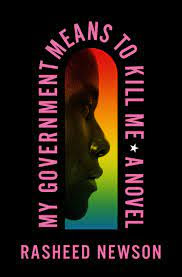
MY GOVERNMENT MEANS TO KILL ME: A NOVEL


By Rasheed Newson


(Flatiron Books, 2022)


A few months ago, I read a historical gay novel set during the AIDS crisis of the 1980s, Rasheed Newson’s My Government Means to Kill Me: A Novel. The tacked on “A Novel” is important because Newson’s story is heavily footnoted, a practice lending a scholarly quality to the telling. (I think it’s the history geek in me that adores footnotes. They are the equivalent to DVD extras—little anecdotes and explanations that often spur me to exploring online rabbit holes.) Most of Newson’s footnoted references were already familiar to me, having lived through the ’80s and reading my share of both Black history and gay history. It pleased me to know that much of Newson’s extras would offer new learning for others. However, this footnoting, while refreshing and offering something unique in gay fiction, became a hindrance at times. It made the story gimmicky, as the author had, Trey Singleton, his Black gay main character, stumbling into too many historical moments like a queer Forrest Gump. A good idea, taken too far.


And one of the things that felt far too far was the author’s inclusion of Baynard Rustin, a real life Black gay civil rights leader, who becomes a guru for Trey, Rustin’s perch not on top of a Himalayan peak but in a New York bathhouse, a simple white towel around the waist serving as an apparel modification from the draped white cloth worn by cartoon gurus. In Newson’s account, Rustin spends A LOT of time in the bathhouse. I recall at least one scene with him having sex. In a footnote, Newson explains that there is no evidence that Rustin frequented bathhouses. This is when I sighed. I may love footnotes, but I’m aware that many readers skip them. An important clarification will be missed.


Martin Luther King, Jr.
and Bayard Rustin


To some readers, and likely the author himself, this portrayal may come across as humorous, even enlightened. While the novel states this is a pure fictionalization, it feels like an unnecessary stunt. Rustin is credited with being an early mentor of Martin Luther King, Jr. and helping organize the 1963 March on Washington. No doubt, Rustin was as flawed as any human and entitled to a sex life, but this feels like an offensive twist. Call me a prude. 


Still, credit that novel with making me seek out more about the actual life of Bayard Rustin, a name I’d vaguely recognized and associated with the civil rights movement without anything more substantive. I read the Wikipedia blurb and clicked on a few of the footnotes. And then I stumbled upon a picture book about him, A Song for the Unsung: Bayard Rustin, the Man Behind the 1963 March on Washington. I was pleased to find four copies in the Vancouver Public Library system. 


A SONG FOR THE UNSUNG: BAYARD RUSTIN, THE MAN BEHIND THE 1963 MARCH ON WASHINGTON


By Carole Boston Weatherford & Rob Sanders


Illustrated by Byron McCray


(Henry Holt and Company, 2022)


A Song for the Unsung 
is a fitting title for a book about Rustin. Music was an integral part of Rustin’s life. Raised as a Quaker, Rustin attended university with support from a music scholarship and at one point recorded an album of spiritual songs. (All this makes his fictionalized bathhouse presence more of an affront.) In many ways, he was an unsung civil rights leader due, in part, to being an openly gay man. His activism took place behind the scenes since his homosexuality was considered a distraction and a way to disparage not only Rustin but civil rights activism. How far we’ve come to have a picture book celebrate the life of Bayard Rustin and, in particular, his leadership in organizing the March of Washington, an event attended by 250,000 and the occasion when Martin Luther King, Jr. gave his “I Have a Dream” speech. The book doesn’t focus on Rustin being gay, offering only a passing reference: “As a young Black gay man, Bayard Rustin was also learning about another kind of inequality and injustice.” 


Rustin during his later years, skirted any attempts to cast him as someone who fought for gay rights. In his own words:

I was not involved in the struggle for gay rights as a 

youth ... I did not "come out of the closet" voluntarily

—circumstances forced me out. While I have no 

problem with being publicly identified as homosexual, 

it would be dishonest of me to present myself as one 

who was in the forefront of the struggle for gay rights.  


While Rustin was open with peers about being gay, the matter became public knowledge due to an arrest in Pasadena in 1953 for allegedly have sex with two other men in a parked car. He pleaded guilty to “sex perversion” and served sixty days in jail. Rustin received a posthumous pardon from California Governor Gavin Newsom in 2020.


In My Government Means to Kill Me, Rasheed Newson portrays Rustin as a wise advisor to Trey and Rustin’s social activism is referenced. I have no idea how Rustin would react to the portrayal of him being a regular presence at a bathhouse. Maybe he’d shrug, maybe he’d roll his eyes, maybe he’d pick up present-day lingo and say, “WTF?” It seems as dignified of a response as warranted.


Rustin wasn’t a saint. As well, some of his political leanings and his motivations may be questionable. All that is worth of research and scores of footnotes. To make him a bathhouse fixture comes off as trivializing and downright rude.


I shall close this post, recasting Bayard Rustin in a more accurate, reverential regard, quoting from Barack Obama in 2013 when Rustin was posthumously awarded the Presidential Medal of Freedom:

Bayard Rustin was an 

unyielding activist for 

civil rights, dignity, 

and equality for all. 

An advisor to 

the Reverend Dr. Martin Luther King, Jr., he promoted nonviolent resistance, participated in one of the first Freedom Rides, organized the 1963 March on Washington for Jobs and Freedom, and fought tirelessly for marginalized communities at home and abroad. As an openly gay African American, Mr. Rustin stood at the intersection of several of the fights for equal rights.


Wednesday, September 6, 2023

HIJAB BUTCH BLUES (Book Review)


By Lamya H


(The Dial Press, 2023)


I’ve been underwhelmed by the many queer memoirs I’ve read from younger writers during the past several years. Typically, my impression is the writer doesn’t have enough perspective yet. There’s always a danger of a memoir coming off as self-absorbed and that seems more likely when the writer doesn’t have enough lived experiences. The woe and the wow come off as overdone.


After a couple of my writing friends, one lesbian, the other trans, had spoken favorably of Hijab Butch Blues, I tracked down a copy. For what she refers to as her own safety, the writer uses the pseudonym, Lamya H. The book offers a different take on a person’s coming to terms with queer identity. Uprooted from an unnamed country of birth (Afganistan? Pakistan?), Lamya lived most of her childhood and teens in an Arab country, feeling different based on being darker skinned and less affluent than the people who held status. Her sense of difference grew as she realized a budding queerness, feelings that didn’t have words (other than derogatory associations) within her culture.


Moving to the U.S. for college at seventeen was an exit pass of sorts but also an introduction to another place where her differences made her feel inferior and shunned. It’s hard to get a sense of how old Lamya H is—the vagaries presumably are intentional to guard her identity—but she seems to have a couple of decades of working through queerness to refer to as she writes this memoir.


Each chapter is named for a specific prophet or character in the Quran or, in one case, a group of characters: hard to spot, impish spirits known as jinn. The experiences of the characters in the Quran or told by elders in the case of jinn are related in the particular chapter, interspersed by parallel experiences in Lamya’s life. It’s a unique structure that sets Lamya’s life against a broader context, helping her find new, more personal meaning in the Quran while also interpreting and accepting her own life. The formula helps forgo a self-absorbed telling. 


Readers with fewer minority labels to process may dismiss Lamya’s conflicts. Why continue being a practicing Muslim when the religion is male-dominated and homophobic? The idea of walking away comes easily to those whose religion can be more easily removed from culture, family and the more mundane but ever-present aspects of daily life. I, however, admire Lamya’s efforts to reinterpret her religion, viewing Allah as female or non-gendered, finding power in Yunus who learns when to preach and when it’s better to walk away and rejecting the noble subservience of Asiyah, a queen mistreated by her husband, a Pharaoh, “the most evil man that Allah had ever created.” 


Keeping her identity private,
this is the author photo at
the back of the book.

This memoir is about finding one’s place. Lamya’s journey involves figuring out how her religion and her queerness fit in her life and how she practices both in New York City, where her visual minority status as a brown-skinned women wearing a hijab, both stands out and gets lost in the diverse fabric of the metropolis. 


There are those who will conclude that there is too much compromise in Lamya’s walking along the path she’s created. Maybe there’s too much time struggling with mental and religious gymnastics. It all works for her. I see her as tenacious in the way she questions, processes and balances the mixed influences in her life. I respect the fact she’s creating her own identity based on mixed influences.


It's definitely a memoir worth reading.